We now have a full look at 2025 data from Sift’s Fraud Industry Benchmarking Resource (FIBR), giving fraud and risk teams a clearer picture of how attack patterns and merchant behavior evolved over the past year. With a complete year of data, we can spot seasonal spikes and understand where fraud pressure eased, where costs […]
The post Looking Back on 2025 Fraud Trends with Sift’s Fraud Industry Benchmarking Resource (FIBR) appeared first on Sift.
]]>We now have a full look at 2025 data from Sift’s Fraud Industry Benchmarking Resource (FIBR), giving fraud and risk teams a clearer picture of how attack patterns and merchant behavior evolved over the past year.
With a complete year of data, we can spot seasonal spikes and understand where fraud pressure eased, where costs quietly increased, and how operational decisions shaped outcomes just as much as fraudster tactics.
Here’s what the 2025 data reveals.
The State of Fraud in 2025
Payment Fraud: Reducing Risk Without Rejecting Revenue
Across industries, the average payment fraud attack rate was 3.15% in 2025, 37% lower than the MRC’s reported 5% order rejection rate. The gap between these benchmarks highlights a meaningful difference in how fraud is being detected and managed. Sift customers consistently operate below broader industry averages, reflecting more precise fraud prevention. This precision allows merchants to prevent fraud without running the risk of blocking legitimate transactions and sacrificing customer trust or revenue.
Manual review data reinforces this trend. While the MRC reports that merchants manually screen approximately 23% of orders, Sift’s average manual review rate in Q4 sat at just 2.7%, signaling a significant shift toward automation. For many businesses, this gap represents both an operational challenge and an opportunity to reduce cost and friction while maintaining control.
Despite continued growth in alternative payment methods, credit and debit cards still account for 72.7% of fraudulent payments, largely due to their widespread use. At the same time, financing, including buy now, pay later, showed the highest risk at a 6% fraud rate, emphasizing the need for tighter controls and better visibility as these payment methods continue to scale.
Account Takeover (ATO): The Quiet Persistent Threat
Account takeover attacks averaged 0.99% in 2025 and showed little seasonality compared to payment fraud. Instead, ATO spikes were more closely tied to external events such as large-scale credential leaks. Attackers increasingly use ATO to access stored payment details or personal data, often blending into higher traffic periods like Q4 to avoid detection.
At the same time, 2FA adoption averaged 8.2%, helping keep ATO rates relatively contained. While adoption continues to rise, the data reinforces a consistent takeaway: layered authentication is most effective when teams are prepared to respond quickly to sudden shifts in attacker behavior.
Chargebacks: The Cost Curve That Keeps Climbing
In 2025, the average general chargeback rate reached 0.22%, while fraudulent chargebacks remained lower at 0.11%, indicating that economic pressure and first-party misuse are driving a growing share of disputes. General chargeback rates increased 41% year over year, reinforcing that chargebacks remain a rising cost even when fraud itself is relatively stable.
Industry Fraud Patterns
Across verticals, one theme stood out in 2025: operational choices materially shape fraud outcomes.
In digital commerce, both payment fraud attack rates and manual review rates declined toward the end of the year, reflecting a common holiday strategy where merchants increase risk tolerance to approve more transactions during peak demand.
Internet and software companies saw an average payment fraud attack rate of 3.4% in 2025, slightly above the overall benchmark. This reflects a higher risk tolerance paired with lower manual review rates, which many companies offset by increasing reliance on controls like two-factor authentication.
The online gambling industry reported the lowest payment fraud rate at 0.16%, driven by risk monitoring that extends beyond upfront checks. Ongoing coordination across fraud, compliance, and responsible gambling throughout the player lifecycle makes context essential when interpreting benchmarks in regulated environments.
Looking Ahead: Cleaner Systems, Fewer Tradeoffs
In an environment where fraud patterns are increasingly hard to predict, the most effective teams focus on precision. That starts with reviewing and cleaning up data so teams can operate with confidence, even as conditions shift.
Risk tolerance also can’t be static. Fraud teams need to continuously assess risk in proportion to seasonal demand, holiday traffic, business goals, and merchant context. By aligning controls to these realities, teams can protect revenue and trust without relying on rigid rules that break when conditions change.
How to Use FIBR
FIBR is designed to provide context, not conclusions. It helps teams understand what’s typical for their industry, where they diverge, and which questions are worth investigating further.
The public version of FIBR is available to anyone, offering high-level benchmarks across industries. Sift customers can access deeper insights directly in the Sift Console and through the Sifters community, including additional breakdowns by payment method, order value, and chargeback reason.
Explore FIBR to see where you stand and where to go next.
The post Looking Back on 2025 Fraud Trends with Sift’s Fraud Industry Benchmarking Resource (FIBR) appeared first on Sift.
]]>The iGaming industry is entering a new era, and conversations at the recent SBC Player Protection Event made one thing abundantly clear: risk is evolving faster than the systems designed to manage it. Operators preparing for major events like ICE Barcelona need to move past the traditional, siloed approach to compliance. Insights from a panel […]
The post 5 iGaming Industry Shifts Redefining Player Profitability and Risk appeared first on Sift.
]]>The iGaming industry is entering a new era, and conversations at the recent SBC Player Protection Event made one thing abundantly clear: risk is evolving faster than the systems designed to manage it.
Operators preparing for major events like ICE Barcelona need to move past the traditional, siloed approach to compliance. Insights from a panel with leaders from Entain, LeBull, and Sift highlight five key trends that will define player trust, regulatory resilience, and sustainable growth in 2026.
1. Financial Crime Risk & Player Harm Are Merging
Financial crime, such as money laundering, and player harm, including gambling-related problems, used to be treated as entirely separate challenges handled by different teams. Today, that separation is no longer viable.
Behavioral signals like rapid-fire deposits, identity switching, erratic wagering, or unusual session lengths can indicate both financial crime and potential player harm. The challenge is that these signals often sit in different departments, which can create gaps in monitoring.
Operators who recognize that these signals are not isolated “departmental issues” but rather holistic behavioral cues are better positioned to mitigate risk effectively. By connecting the dots between AML, fraud, and responsible gambling, operators can prevent regulatory issues, protect players, and maintain their reputation.
2. Breaking Silos with Holistic Risk Management
Breaking down silos sounds simple in theory, but executing it is a different story. For example, at Entain, cross-functional governance brings together compliance, fraud, product, and business teams to collaborate on risk management.
Shared dashboards and KPIs are just the starting point. The real goal is cultural alignment, making compliance a partner rather than a blocker, and treating risk management as a shared responsibility across the organization.
This unified approach ensures that decisions are informed by the full picture of player behavior, rather than fragmented insights from individual departments. When everyone shares responsibility for the player ecosystem, risk management becomes a strategic advantage instead of a series of regulatory hurdles.
3. Sustainable Growth = Player-Centric Protection
There is a persistent myth in the industry that strict compliance restricts profitability. In reality, compliance protects profit by creating trust and loyalty among players.
The concept of sustainable engagement involves building controls that are effective without being excessive. For example, guardrails should prevent harm while still allowing players to enjoy the games. Individual player context is critical: what might appear as risky behavior for one player could be perfectly normal for another.
Operators who tailor their approach to both player behavior and local regulations build long-term relationships that go beyond a single transaction. Entain, for instance, relies on a combination of systems, people, and processes to ensure that protection measures are consistent, scalable, and continuously improving.
4. Risk Lives Across the Entire Player Journey
Traditionally, operators focused on the “front door”—KYC and registration checks—to prevent fraud and comply with regulations. While necessary, these controls are not sufficient.
Most regulatory exposure arises after an account is created, as players interact with the platform. This includes deposits, withdrawals, session activity, and engagement with customer support. Risk management now requires downstream monitoring that captures behavioral trends throughout the entire player journey.
Moving away from blunt “block everything” approaches, operators are implementing precision friction. These include step-up notifications, targeted alerts, and contextual warnings that address potential issues without disrupting the player experience. This approach allows operators to maintain safety while keeping engagement high, balancing protection and profitability.
5. AI, ML & Human Judgment Must Work Together
Artificial Intelligence (AI) and Machine Learning (ML) are critical tools for modern iGaming operators. AI can process massive datasets, identify bot networks, detect synthetic IDs, uncover collusion, and reveal complex fraud patterns faster than human teams alone.
However, AI has limits. It cannot interpret emotional nuance, subtle shifts in player behavior, or cultural context. This is where human judgment is essential. By combining AI insights with human expertise, operators can apply empathy, context, and reasoning to ensure decisions are responsible and player-centric.
The future of risk management is not purely automated, it’s a hybrid model where technology surfaces insights, and humans provide understanding, context, and intervention. This ensures a safer, more scalable, and trustworthy iGaming environment.
The Big Picture
Across all five trends, one theme is clear: risk management is becoming human-centric, data-driven, and holistic. Financial crime and player harm are interconnected, compliance can enable growth rather than hinder it, and technology must flow across teams instead of remaining in silos. Operators who see the whole player, rather than isolated events, will set the standard for the industry in 2025 and beyond.
Heading to ICE Barcelona? The Sift team will be on the ground to share insights and strategies for unified risk intelligence that helps operators scale safely while protecting players. Schedule a time to chat with us at the conference.
The post 5 iGaming Industry Shifts Redefining Player Profitability and Risk appeared first on Sift.
]]>As we enter the critical holiday shopping season, businesses are facing new and emerging challenges with first-party fraud. Sift’s Q4 2025 Digital Trust Index shows that chargeback rates climbed steadily throughout 2025, reaching 0.26% in Q3, a 53% increase from Q1 2025. Retail e-commerce chargeback rates have exploded by 233% since Q1 2025, the highest […]
The post The “Refund Hack” Economy: Why E-Commerce Chargebacks Surged in 2025 appeared first on Sift.
]]>As we enter the critical holiday shopping season, businesses are facing new and emerging challenges with first-party fraud. Sift’s Q4 2025 Digital Trust Index shows that chargeback rates climbed steadily throughout 2025, reaching 0.26% in Q3, a 53% increase from Q1 2025. Retail e-commerce chargeback rates have exploded by 233% since Q1 2025, the highest increase of any merchant category.
Fueling this growth is the prevalence of “refund hack” tutorials on social media. 22% of consumers surveyed by Sift acknowledge encountering these tutorials on social platforms, with TikTok (34%) and Facebook (29%) serving as the most common channels. Perhaps more concerning: 10% of consumers surveyed by Sift admit to trying these tactics themselves, such as returning worn clothing or filing chargebacks for purchases they actually received and were satisfied with.
The Perfect Storm: Why Now?
Several converging forces are driving this chargeback crisis. First, the expansion of card-not-present (CNP) transactions—now accounting for 63% of merchant transactions—has created more opportunities for disputes. As digital commerce continues its relentless growth, the sheer volume of transactions provides a larger surface area for both legitimate and fraudulent chargebacks.
Second, economic pressure is pushing consumers toward questionable shortcuts. One in five surveyed consumers said they’d be more likely to use refund hacks during times of financial hardship. When paired with the democratization of fraud tactics through social media, this creates what we call “the refund hack economy”—an ecosystem where fraud knowledge is freely shared and normalized.
Fashion Takes the Biggest Hit
The fashion and retail sectors were particularly vulnerable in 2025. Clothing, accessories, and cosmetics rank as the most disputed category for chargebacks at 20%, followed closely by digital subscriptions (18%) and home goods (16%). Among those who admit to first-party fraud, 19% targeted clothing categories specifically.
The reasons consumers rationalize these fraudulent disputes reveal much about the problem’s complexity. Eighteen percent justified false claims because their order didn’t arrive on time, while 17% felt the merchant “behaved unethically” and a chargeback was justified. Twelve percent wanted their money back and knew their credit card company would cover the cost.
“As disputes and chargebacks continue to rise, and first-party fraud becomes an increasingly significant part of overall dispute volume, businesses face growing operational and financial pressures,” says Alexander Hall, Trust and Safety Architect at Sift. “Leveraging proactive fraud prevention and streamlined dispute management helps companies reduce losses, protect revenue, and maintain long-term customer trust.”
The Ripple Effects
The impact extends far beyond the immediate financial loss. With U.S. merchants losing an estimated $4.61 for every $1 in chargebacks, the operational burden is substantial. But the reputational damage may be even more severe: 62% of consumers say they would be less likely or would stop entirely shopping with a brand after experiencing fraud, with 21% saying they’d stop completely.
This creates a vicious cycle. Twenty-four percent of consumers who filed a dispute due to fraud subsequently became victims of additional online fraud, suggesting that compromised payment methods weren’t shut down quickly enough, leading to payment fraud (52%), scams (51%), and account takeover (29%).
What Merchants Can Do
As first-party fraud becomes more common, merchants need a multi-layered response encompassing real-time transaction analysis to identify potential fraud before authorization, automated dispute management to prioritize winnable cases, clear customer communication to reduce confusion-driven disputes, and proactive refund strategies for borderline cases in which the cost of fighting exceeds the transaction value.
For merchants, the holiday season ahead demands vigilance and a renewed focus on the customer experience that prevents legitimate disputes before they start.
Read the full Q4 2025 Digital Trust Index report for more insights on disputes and chargebacks.
The post The “Refund Hack” Economy: Why E-Commerce Chargebacks Surged in 2025 appeared first on Sift.
]]>Black Friday and Cyber Monday 2025 delivered record consumer demand and, predictably, record risk. An estimated 202.9 million U.S. shoppers participated across the five-day holiday stretch, with U.S. Black Friday e-commerce sales reaching $11.8 billion and global spending climbing to $79 billion. As expected, fraud followed the money. Across the Sift Global Data Network, transaction […]
The post Black Friday 2025 Fraud Trends: ATO Surges, High-Value Attacks, and What to Expect in 2026 appeared first on Sift.
]]>Black Friday and Cyber Monday 2025 delivered record consumer demand and, predictably, record risk. An estimated 202.9 million U.S. shoppers participated across the five-day holiday stretch, with U.S. Black Friday e-commerce sales reaching $11.8 billion and global spending climbing to $79 billion. As expected, fraud followed the money.
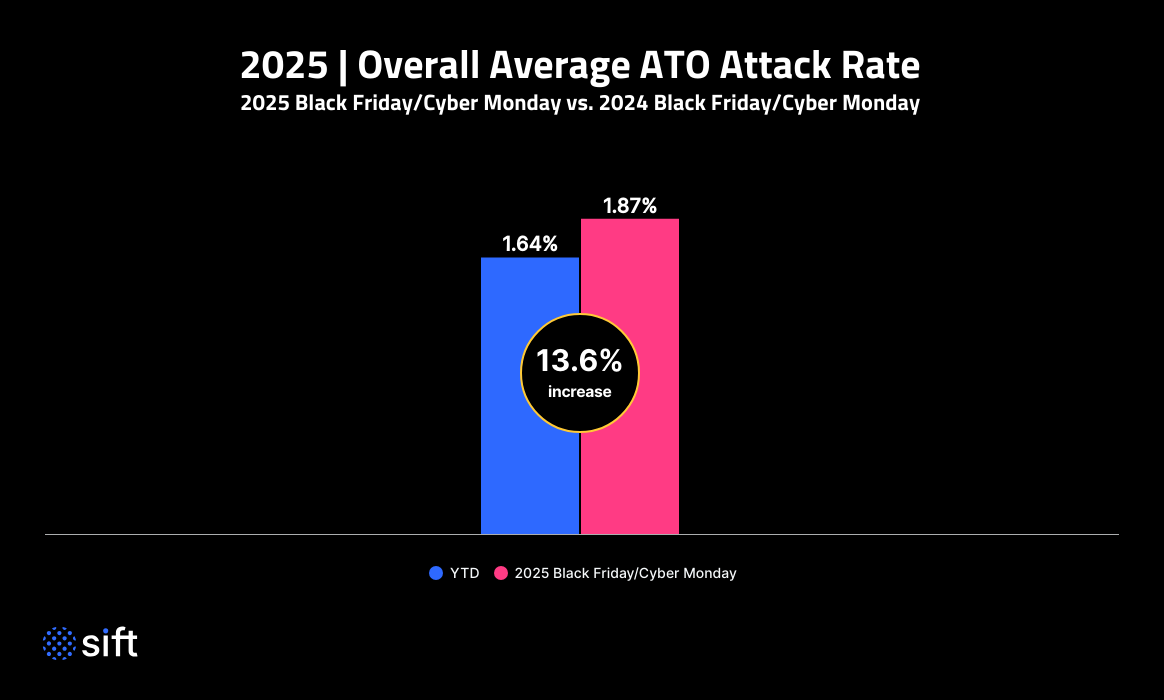
Across the Sift Global Data Network, transaction volume during BFCM rose 13.8% year-over-year compared to 2024. Overall account takeover (ATO) attack rates climbed 13.6% above 2025 year-to-date levels, increasing from 1.64% to 1.87%. While these attacks were blocked by Sift before resulting in chargebacks or losses, the year-over-year growth highlights how aggressively fraudsters exploited peak traffic as cover for scaled attacks.
High-Velocity Markets Remain Prime Targets
Convenience-driven markets remain especially exposed during peak periods. E-commerce, fintech, digital platforms, and travel all prioritize speed, automation, and low friction during seasonal surges. These same conditions create ideal cover for coordinated fraud campaigns targeting both accounts and transactions.
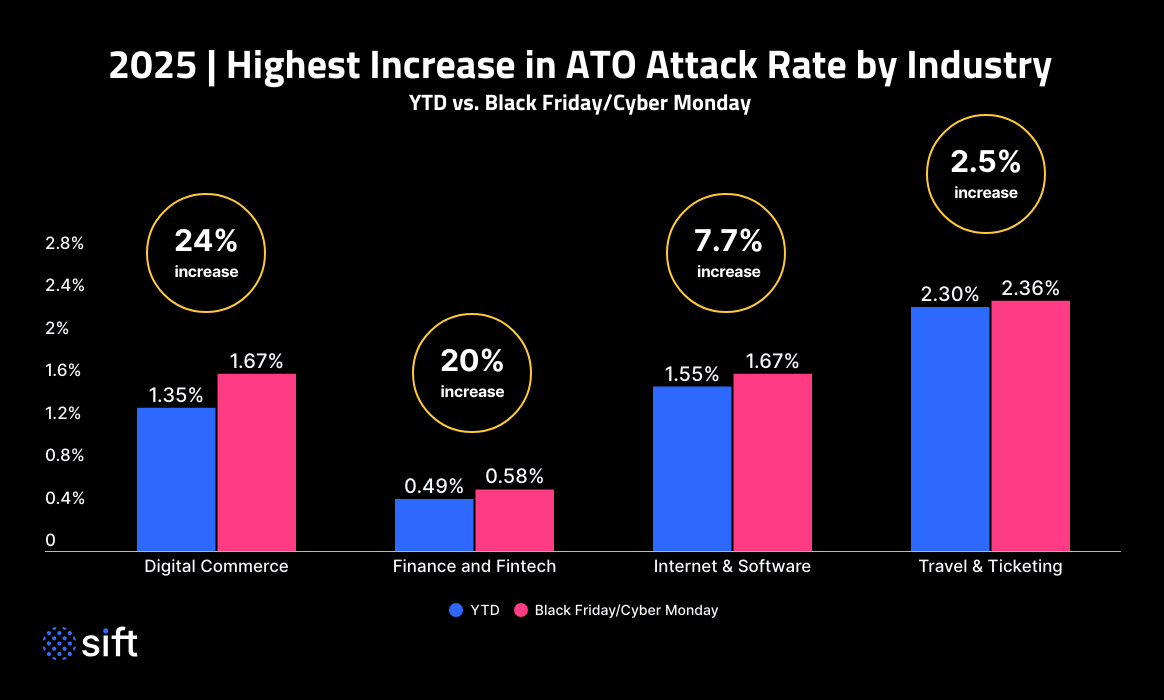
During BFCM 2025, digital commerce saw a 24% increase in ATO compared to 2025 year-to-date levels, rising from 1.35% to 1.67%. Finance and fintech followed with a 20% increase, from 0.49% to 0.58%. Internet and software platforms experienced a 7.7% rise, climbing from 1.55% to 1.67%. These increases show how automated login abuse continues to rise in direct correlation with revenue opportunity.
Travel and ticketing recorded some of the highest ATO rates across industries, increasing from 2.30% to 2.36% during BFCM 2025. While the percentage change was smaller than in other industries, the absolute risk remains elevated due to the high resale value and time-sensitive nature of inventory. Seasonal demand continues to intensify already challenging fraud conditions in this sector.
Fraud Economics Are Shifting
Across the Sift Global Data Network, the average value of attempted fraudulent transactions fell 16% overall during BFCM 2025, declining from $138 to $116. This trend reflects widespread low-dollar testing behavior designed to evade detection while validating stolen credentials and payment methods.
However, digital commerce told a very different story. The average value of attempted fraudulent transactions across e-commerce surged 93%, jumping from $130 to $250. This sharp increase shows that fraudsters didn’t just follow volume; they doubled down on high-value retail transactions where the payoff was greatest and detection was masked by seasonal demand.
AI-Driven Scams and Shopping Agent Abuse Are Accelerating
BFCM 2025 also reflected the growing influence of generative AI on fraud tactics. Cybercriminals are now using AI to produce highly convincing phishing campaigns, fake storefronts, and impersonated brand experiences promoted through paid ads and manipulated search results on reputable sites. These scams replicate real brands with striking accuracy, harvesting credentials and payment details at scale before disappearing.
At the same time, consumer shopping behavior is shifting rapidly toward AI-driven discovery. Nearly half of consumers now use AI as a primary way to find products, with curated answers increasingly shaping purchases before brands ever interact with buyers directly. As agentic commerce accelerates toward a projected $1 trillion in U.S. retail revenue by 2030, new automated risk vectors are emerging, including bulk purchasing, inventory draining, and promotion abuse at scale. With automation on both sides of the transaction, attack velocity is accelerating during peak shopping events.
What This Means for 2026
Holiday ATO surges historically lead to higher disputes in the following quarter as compromised accounts are monetized, only surfacing on billing statements weeks later. With elevated ATO across commerce and fintech during BFCM 2025, businesses should prepare for sustained chargeback pressure entering early 2026.
Actionable priorities for risk and payments teams include:
- Automate risk decisions at scale. Transaction surges make manual review unsustainable. Instead of broadly lowering thresholds and increasing exposure, use machine learning and automated workflows to adapt dynamically to shifting risk. Automation allows teams to block suspicious activity in real time while preserving approval rates for trusted customers.
- Proactively shut down account takeovers. Protecting accounts during peak traffic is essential to long-term customer trust. Use real-time signals to verify suspicious logins and immediately trigger automated security notifications that alert customers to unusual activity without interrupting their experience.
- Apply step-up authentication when needed. For higher-risk events—such as attempts to change account details, add new payment methods, or transact at high value—use step-up authentication to confirm the activity before the action proceeds. This helps contain ATO attempts beyond login while applying friction only when risk warrants it.
- Prioritize post-purchase experience to reduce downstream risk. Extended promotions, returns, and shipping delays increase dispute exposure. Clear policies, easy refunds, and proactive customer service during the holidays reduce the likelihood that customers escalate directly to chargebacks later.
- Maximize analyst efficiency during peak review periods. Seasonal spikes routinely overload fraud teams. Use automated acceptance and blocking thresholds to reserve manual review for truly ambiguous cases, improving both speed and accuracy under pressure.
- Establish clear escalation paths before attacks hit. Large-scale fraud events require fast cross-functional response. Define escalation protocols across risk, engineering, and operations ahead of time, and assess system vulnerabilities before code freezes lock in limited flexibility.
- Prepare now for chargeback season. The first quarter consistently brings elevated disputes tied to holiday fraud and buyer behavior. Clear return and cancellation policies help reduce losses from first-party misuse and unwinnable disputes.
Adaptive Fraud Prevention for Seasonal Volatility
Seasonal demand now brings seasonal attack cycles. Managing that volatility requires connected, adaptive fraud prevention. Sift combines global machine learning, device intelligence, and behavioral signals to stop automated abuse and high-impact fraud at scale.
With innovations like Sift’s RiskWatch, businesses can adjust block rates dynamically in real time as fraud patterns shift, maintaining strong protection during surge events like Black Friday without adding unnecessary friction.
As organizations move into 2026, the ability to block automated abuse, high-value attacks, and AI-driven scams at scale will separate those that grow confidently from those that fall behind.Explore more industry benchmarks through FIBR, the Fraud Industry Benchmarking Resource, the first-ever fraud benchmarking tool that lets you compare your business’s fraud rates to industry averages across our vast global data network.
The post Black Friday 2025 Fraud Trends: ATO Surges, High-Value Attacks, and What to Expect in 2026 appeared first on Sift.
]]>Account takeover (ATO) fraud is accelerating in both scale and sophistication. Findings from Sift reveal how fraudsters are moving beyond credential stuffing and brute-force tactics, using automation and AI to imitate legitimate users, bypass detection systems, and exploit weak defenses. These evolving methods are forcing businesses to rethink how they establish and maintain digital trust. […]
The post Inside the Rise of ATO: How Agentic AI Is Rewriting the Rules of Digital Trust appeared first on Sift.
]]>Account takeover (ATO) fraud is accelerating in both scale and sophistication. Findings from Sift reveal how fraudsters are moving beyond credential stuffing and brute-force tactics, using automation and AI to imitate legitimate users, bypass detection systems, and exploit weak defenses. These evolving methods are forcing businesses to rethink how they establish and maintain digital trust.
ATO Attacks Are Growing Smarter and Faster
Account takeover is one of the fastest-growing threats in digital commerce. In 2025, 83% of organizations experienced at least one incident, and projected losses are climbing to $17 billion, up from $13 billion last year. Bots, malware, and AI-driven attacks, including deepfakes, credential stuffing, and fraud-as-a-service kits, are automating account compromises at scale.
Sift’s Q3 2025 Digital Trust Index shows ATO attempts rose 4% year-over-year, with the steepest spikes in e-commerce, fintech, and internet & software. AI is enabling attackers to scan for weak points, simulate legitimate behavior, and bypass traditional detection. Consumers are feeling the impact, with 14% reporting having experienced ATO in the past year, often leading to downstream fraud like payment abuse or loyalty point theft.
How Agentic AI is Changing the Game
ATO tactics have evolved beyond simple login attacks. Fraudsters can now use agentic AI to run adaptive, end-to-end campaigns that can compromise thousands of accounts simultaneously, exploiting weak points at unprecedented speed.
Unlike traditional automation, agentic AI can reason, plan, and act autonomously, adjusting its tactics in real time. These AI agents mimic legitimate behaviors, such as device movement, purchase timing, and login patterns, making static defenses and periodic updates increasingly ineffective. Businesses now need continuous learning and adaptive decisioning to interpret complex identity signals and stop attacks before they escalate.
Consumers are already wary of AI agents: 74% say AI shopping agents increase concern about ATO, and only 14% would let an AI agent shop for them. Confidence in AI handling sensitive data is low, with just 35% trusting an agent to securely handle their financial information and make purchases on their behalf. The rise of agentic AI is amplifying fraud costs, operational complexity, and the stakes for maintaining customer trust.
The Human Impact: Trust on the Line
The consequences of ATO extend beyond financial loss. Victims often experience reputational damage, loss of loyalty points or stored value, and persistent anxiety about their digital safety.
Consumers are becoming more aware of these risks. Sift’s research shows that 75% of consumers would permanently stop using a brand after their account was compromised. Over half take additional steps to secure their accounts, and 37% describe themselves as very or extremely worried about being hacked.
For digital businesses, these concerns translate directly into churn risk, higher customer acquisition costs, and lasting damage to brand reputation. Protecting accounts is no longer just about preventing fraud, it’s about preserving customer trust.
Fighting ATO with Adaptive AI
Stopping sophisticated ATO attacks requires more than stronger authentication, it demands a dynamic, identity-centric approach. Sift helps businesses combine real-time behavioral, device, and intent signals with global insights to detect fraud early. By leveraging global models, industry-specific cohorts, and threat cluster modeling, businesses gain a “herd safety” effect, seeing attacks before they reach them.
AI, while enabling complex attacks, can also power smarter defenses when applied strategically. Tools like Sift’s ActivityIQ leverages generative AI to allow you the option to rapidly surface and summarize user actions across multiple sessions, giving your team quick, natural language insights to sift through the noise and aid in making faster ATO fraud decisions.
An advanced ATO strategy layers defenses: bot detection at login, ongoing verification after login, and intent-focused monitoring for sensitive actions. This approach ensures legitimate users enjoy seamless experiences while fraudsters are stopped in their tracks, reducing both financial and reputational risk.
The post Inside the Rise of ATO: How Agentic AI Is Rewriting the Rules of Digital Trust appeared first on Sift.
]]>The pace of innovation in fraud prevention is accelerating, and so are the stakes. As AI reshapes both digital commerce and cybercrime, businesses need solutions that can spot suspicious behavior, make smart decisions, and respond quickly. That’s why we’re proud to share that Sift has been named a Leader in QKS Group’s SPARK Matrix™: eCommerce […]
The post Sift Named a Leader in the QKS Group SPARK Matrix™ for eCommerce Fraud Prevention, Q4 2025 appeared first on Sift.
]]>The pace of innovation in fraud prevention is accelerating, and so are the stakes. As AI reshapes both digital commerce and cybercrime, businesses need solutions that can spot suspicious behavior, make smart decisions, and respond quickly.
That’s why we’re proud to share that Sift has been named a Leader in QKS Group’s SPARK Matrix™: eCommerce Fraud Prevention Solutions, Q4 2025.
The SPARK Matrix™, published by global advisory firm QKS Group, provides an independent evaluation of vendors based on technology excellence and customer impact. Sift earned the distinction of being the highest-ranked independent company in the report, underscoring our role as a trusted, AI-powered fraud platform delivering identity intelligence for global brands.
The Evolution of Fraud Prevention
According to QKS Group, the next phase of eCommerce fraud prevention will be defined by intelligence, integration, and identity. Traditional point solutions that address isolated threats are giving way to connected, AI-driven platforms that bring together fraud prevention, identity, and cybersecurity.
This shift aligns perfectly with our vision and the platform we’ve built. As fraud becomes more automated and tied to identity, businesses need end-to-end visibility across the digital journey and the flexibility to respond fast to new threats.
Why Sift was Recognized as a Leader
In its SPARK Matrix™ analysis, QKS Group highlights how Sift brings together data, flexibility, and scale to stay ahead of modern fraud threats. Specifically, the report cites:
- Comprehensive data integration with pre-built connectors, flexible APIs, and real-time data synchronization, giving businesses a complete, actionable view of the digital customer journey.
- Advanced machine learning that adapts across global, industry, and custom models, continuously learning from Sift’s network to stay ahead of evolving fraud.
- Real-time detection and interdiction that quickly identifies anomalies and blocks high-risk activity before it impacts revenue or customers.
- Sophisticated alerts and case management provides users with real-time alerts and a centralized case workspace where analysts can triage, investigate, and resolve events.
- Strong visualization and reporting through a centralized console that surfaces risk signals, model outcomes, and operational KPIs in configurable views, with drilldowns to users or events.
- PSD2/SCA program support including dynamic friction, transaction risk analysis, and exemption optimization to ensure compliance while maintaining smooth customer experiences.
QKS Group analysts noted that Sift’s balanced approach to advanced AI and practical implementation stands out in a rapidly evolving market:
“Sift has established a differentiated position in the market by architecting a platform that balances sophisticated machine learning with operational practicality,” said Divya Baranawal, VP Research at QKS Group. “What stands out is their ability to serve diverse high-velocity sectors—from retail to fintech to gaming—with a unified intelligence framework that learns across verticals. This cross-industry data advantage, combined with their focus on reducing analyst workload through generative AI and intuitive workflows, positions them well to address the evolving complexity of eCommerce fraud.”
Leading the Way Toward Intelligent, Identity-Driven Protection
This recognition is both validating and motivating. It reflects where the industry is headed and the shared success of our customers who continue to innovate with us.
Fraud has shifted from a payments problem into an identity problem. Stopping it takes collaboration, continuous learning, and technology that can adapt as fast as attackers do.
We’re building a future where businesses can grow confidently, customers can transact freely, fraud teams can work efficiently with AI instead of being overwhelmed by it.
Access the Full Report
Get your complimentary copy of the QKS Group SPARK Matrix™: eCommerce Fraud Prevention Solutions, Q4 2025 to see why Sift was named a Leader and how our AI-powered platform is redefining online trust.
The post Sift Named a Leader in the QKS Group SPARK Matrix™ for eCommerce Fraud Prevention, Q4 2025 appeared first on Sift.
]]>Fraud presents a serious and continuous risk for businesses. Evolving AI technology is being trained by bad actors to infiltrate, steal, and mislead, resulting in financial losses, scams, chargebacks, and account takeovers (ATO) that damage both brand reputation and the bottom line. In 2024, American businesses lost more than $12.5 billion to fraud, while global […]
The post 7 Best Fraud Prevention Software Platforms for Protecting Your Business appeared first on Sift.
]]>Fraud presents a serious and continuous risk for businesses.
Evolving AI technology is being trained by bad actors to infiltrate, steal, and mislead, resulting in financial losses, scams, chargebacks, and account takeovers (ATO) that damage both brand reputation and the bottom line.
In 2024, American businesses lost more than $12.5 billion to fraud, while global losses hit nearly $50 billion per year—with around 80% lost to attempted payment fraud. Nearly 60% of companies report that fraud losses continue to increase in 2025, and in financial institutions and fintech, almost 30% of organizations have reported losses breaching $1 million.
Selecting the appropriate fraud detection and prevention vendor for your business means understanding which features to consider, where budgetary restrictions impact performance, and how each service directly aligns with your business’s particular needs.
Features to Look For in Fraud Prevention Software
Choosing the right fraud prevention software is dependent on a company’s needs, and understanding the core features of each fraud prevention solution is the first step. Businesses need tools that can adapt to evolving threat tactics, support cybersecurity efforts, are accurate and prompt, and will serve the fraud team while delivering seamless customer experiences.
Monitoring and Analysis
Real-time monitoring is one of the more important aspects of a fraud detection tool. Rather than relying on static, outdated rules, scalable platforms continuously analyze transactions and interpret user signals to spot suspicious patterns. This proactive approach stops fraudsters faster, reduces losses and chargeback fraud, and builds a strong foundation for future-proof fraud prevention.
Device Fingerprinting and Pattern Recognition
A user’s device can tell you a lot about that user’s intentions. Their browser type, IP address, operating system, location data, frequency of purchases, and more can be used to identify suspicious behavior quickly and, as databases grow, with incredible accuracy. The best fraud prevention tools help you identify suspicious patterns and turn your fraud tolerance according to your industry and business needs.
Machine Learning and AI
Modern fraudsters adapt fast, leaving rule-based systems behind. AI and machine learning in fraud detection excel at spotting emerging threat patterns, learning from new data, and improving accuracy over time. This intelligence cuts down false positives, meaning fewer legitimate customers get flagged, and more fraud attacks are stopped before they cause damage.
Customization
Fraud and fraud prevention doesn’t look the same everywhere. Each industry, down to the individual market, faces its own risks and tolerance levels. An SaaS platform might focus on account takeovers, where an e-commerce merchant would be more concerned about first-party fraud. Food and delivery businesses process countless low-value transactions, requiring a lower fraud threshold to focus on lower transaction friction. Tech companies that handle fewer, higher-ticket sales would want to have a higher threshold for fraudulent transactions, as every chargeback means a much greater loss. Flexible fraud prevention adapts to these differences, letting teams design workflows, set thresholds, and understand exactly why a user was flagged, so they stay in control and make faster, more confident decisions that directly protect revenue.
Transparency
The most effective fraud detection software explains why a transaction looks suspicious while immobilizing the risk. Transparent risk scoring gives teams the context they need to spot patterns, refine strategies, and build smarter defenses. It also helps businesses calibrate their approach: companies selling high-value items can tighten controls, while those managing many low-value transactions can focus on keeping checkout friction low.
Scalability
Fraud prevention shouldn’t break under growth. As you enter new markets, launch products, or handle surges in transactions, your protection needs to keep pace. Sift’s Global Data Network draws on insights from millions of activities and transactions across industries worldwide, spotting patterns that signal account takeovers, stolen payment data, and other digital threats.
Below, we’ve highlighted the 7 best fraud detection solutions available for growing and enterprise companies, focusing on their key features, technology strengths, and pricing models to help you choose the best fit for your business.
Top Fraud Prevention Software Solutions
Sift
Sift is an AI-driven fraud decisioning platform that delivers identity intelligence to global businesses. With a Global Data Network of 1 trillion annual events and advanced ML models, Sift offers industry leading insight into user behavior through hundreds of meaningful user signals (IP location data, transaction frequency, compromised user information, and more) across nearly all industries.
Sift maintains #1 position across all fraud prevention categories in G2’s Fall 2025 Reports in Fraud Detection, E-Commerce Fraud Protection, and Risk-Based Authentication. Clearbox Decisioning gives Sift customers the ability to tune their fraud prevention to their specific industry and business needs. These features combined lets Sift offer extremely high accuracy in internet and software, online gambling, food and delivery, travel and transportation, and e-commerce fraud prevention while providing near-frictionless experiences for legitimate consumers.
Sift protects more than 700 different brands across the globe, including Hertz, Yelp, and Poshmark.
Standout Features
- Accurate fraud detection
- Real-time decisioning
- Scalable for high transaction volumes
- Easy API integration
- Clear risk scoring and insights
- Protection across payments and accounts
- Responsive customer support
Forter
Forter offers protection that helps businesses approve or block transactions. The platform integrates with online retailers to deliver decisions aimed at preventing fraud without disrupting the customer experience. Using machine learning and behavioral analytics, Forter evaluates a range of signals to reduce false declines, limit fraud losses, and protect customer accounts from abuse.
Standout Features
- Real-time decisioning
- Seamless integration with e-commerce platforms
- Advanced machine learning analytics
- Account protection features
Kount
Kount is a trust and safety platform that lets businesses choose the solutions that fit their specific challenges. It combines data-driven decisioning, machine learning, and historical fraud expertise to help organizations to support consistent fraud prevention across customer interactions.
- Easy to navigate
- Highly customizable
- Chargeback reduction
- Real-time monitoring
- Account management support
SEON
SEON is a fraud prevention platform designed for real-time risk scoring, identity verification, and reducing manual review. Users on G2 say SEON spots suspicious behavior quickly, gives visibility into digital footprints and device data, and lets teams build and adjust rules without heavy technical overhead.
- User interface designed for ease of navigation
- API-friendly solution
- Transparent risk scoring
- Flexible, modular pricing model
Signifyd
Signifyd is a commerce protection platform focused on preventing fraud and abuse across the ecommerce journey. It uses machine learning, risk scoring, and its wide commerce network to provide automation, real-time decisions, and a 100% financial guarantee against fraud for approved orders. According to users, the platform is designed to reduce chargebacks, streamline operations, and add visibility into fraud and merchant operations through actionable reporting.
- Automated approvals and declines
- 100% chargeback guarantee on approved orders
- Intuitive, easy-to-use dashboard for reporting and performance tracking
Accertify
Accertify is a fraud prevention and risk management platform that helps businesses fight abuse, manage disputes, and optimize payments. The platform integrates fraud detection, account protection, dispute management, and payment gateway features to help reduce fraud losses and chargebacks while improving operational visibility. Accertify is used across industries like travel, ecommerce, financial services, and telecommunications.
- Unified, comprehensive dashboard
- Easy to integrate
- Can be used for complex fraud use cases
- Robust fraud detection and device intelligence
Riskified
Riskified is an ecommerce fraud prevention platform that provides risk decisions and protects approved orders with a full chargeback guarantee. It uses real-time monitoring, machine learning, device tracking, and behavioral signals to spot fraud, bot activity, and risky transactions.
- Strong fraud detection, especially for fake accounts
- Real-time monitoring and alerts
- Dashboard and order risk visibility
- Chargeback guarantee
- Responsive support and helpful onboarding staff
Ravelin
Ravelin is an fraud prevention platform built to help online merchants secure the customer journey and accept more payments. Its solutions include real-time fraud detection, graph network analysis, and customizable rule engines. Ravelin also emphasizes helping businesses adapt to changing fraud patterns via investigative analytics and machine learning.
- Real-time detection and alerts
- Graph network functionality to spot complex fraud
- Customizable rules and policies
- Onboarding and technical support
Protect your Business from Fraud with Sift
Fraud prevention is foundational, and today’s fraudsters automate at scale, weaponizing stolen identities and exploiting decades of leaked data to adapt faster than most defenses can respond. For digital businesses, the challenge is to stop bad actors without breaking customer trust or slowing down growth.
Sift delivers the intelligence and infrastructure necessary to stay ahead. Powered by decades of experience, data, and applied machine learning, Sift’s Global Data Network connects identity, behavior, and intent, revealing the context behind every interaction and helping teams understand decisions. This visibility enables precise workflows, smarter thresholds, and faster, more confident decisions.
Get Sift’s evaluation guide to identify opportunities to improve your fraud stack.
The post 7 Best Fraud Prevention Software Platforms for Protecting Your Business appeared first on Sift.
]]>The Q3 2025 update to Sift’s Fraud Industry Benchmarking Resource (FIBR) is now live, and this quarter’s data tells a story of shifting tactics and major differences between industries. As a Trust & Safety Analyst, I spend my days tracking these patterns to understand where fraudsters are innovating and where defenses are holding strong. FIBR […]
The post New Q3 2025 Data Available in Sift’s Fraud Industry Benchmarking Resource (FIBR) appeared first on Sift.
]]>The Q3 2025 update to Sift’s Fraud Industry Benchmarking Resource (FIBR) is now live, and this quarter’s data tells a story of shifting tactics and major differences between industries.
As a Trust & Safety Analyst, I spend my days tracking these patterns to understand where fraudsters are innovating and where defenses are holding strong. FIBR gives us the high-level context behind those shifts so we can see what’s normal, what’s new, and what might be coming next.
Here’s what the latest data reveals.
Key Takeaways
- Payment fraud attack rate remained stable at 3.1% overall, with a 6% year-over-year decline
- Manual review rate dropped 21% YoY to 2.2% in Q3 2025
- 72.8% of fraudulent payments were made by credit/debit card
- Cryptocurrency fraud surged 110% YoY, making it the riskiest payment method this quarter with a 6.7% fraud rate
- Chargebacks tell a mixed story: general chargebacks rose 24% YoY, but fraudulent chargebacks fell 25%
- Account takeovers declined 55% YoY, supported by a 10% increase in 2FA adoption
The State of Fraud in Q3 2025
Payment Fraud: Consistent Rates, Evolving Tactics
The payment fraud attack rate has remained fairly steady this year, but dipped slightly in Q3 2025, down 6% YoY from 3.3% to 3.1%. Manual review rates also dropped, from 2.8% to 2.2%, suggesting that trust and safety teams are leaning further into automation to manage scale without slowing the customer experience.
The overwhelming majority of fraudulent payments (72.8%) still come from credit or debit cards, but the 6.7% cryptocurrency fraud rate stands out. At just shy of 7%, it’s the highest of any payment type, highlighting a trend of attackers moving into newer payment methods that have fewer guardrails. Even as AI-driven defenses grow more precise, fraudsters are experimenting faster, especially in emerging payment ecosystems.
Chargebacks: Disputes are Rising, Fraudulent Claims Falling
Chargeback data tells a nuanced story this quarter, with general chargebacks rising 24% year-over-year (0.21% → 0.26%) while fraudulent chargebacks fell 25% (0.28% → 0.12%).
This trend points to two key dynamics: merchants are getting better at documenting and disputing false claims, and consumers—facing ongoing economic pressure—are more likely to initiate first-party fraud disputes. The takeaway is that not all increases in chargebacks are signs of fraud; however, they remain costly, and proactive refund communication can prevent many from escalating to formal disputes.
Account Takeovers: ATOs down, 2FA Paying Off
The biggest drop this quarter came in account takeover (ATO) attacks. Rates dropped 55% YoY (1.3% → 0.59%), while 2FA adoption rose 10% (7.1% → 7.8%).
We’re seeing a clear cause-and-effect relationship here, where more layered authentication leads to fewer takeovers. But ATO remains volatile; attackers often go dormant and then reemerge with new automated or AI-powered approaches. As always, preparation matters more than prediction. If you wait for the next wave to appear, it’s already too late.
Industry Trends: Where Fraud is Heating Up
Fraud doesn’t hit every sector the same way. Here’s what stood out this quarter across key verticals:
Digital Commerce
The payment fraud attack rate rose 43% YoY (1.6% → 2.3%) across digital commerce, but still remains below the overall average of 3.1%. Manual reviews dropped from 4.9% to 3.3%, reflecting growing trust in automated decisioning.
Fraud tactics are shifting as AI-generated listings, deepfake sellers, and agentic bots drive new forms of first-party and reseller fraud, especially in high-value categories like luxury and trending goods (e.g., Labubus). Merchants should focus on refining identity and behavioral signals to separate trusted users from synthetic ones.
Commerce marketplaces specifically were also hit hard, with payment fraud attack rates up 40.7% YoY (2.7% → 3.8%). As these platforms grow, they’re seeing more first-party fraud, often fueled by social media “refund fraud” trends.
Travel & Ticketing
The travel and ticketing industry continues to strengthen account security even as it faces a rise in chargebacks. Account takeover (ATO) attacks are down 59% year-over-year, while two-factor authentication (2FA) adoption has increased 25%, reaching a 12% adoption rate—the highest across all industries. While stronger authentication is clearly making a difference, chargebacks are trending upward, reflecting a tougher refund environment. The challenge for travel businesses now lies in maintaining this higher level of verification without adding unnecessary friction for trusted, repeat travelers.
Food & Delivery
Fraud in food delivery is highly seasonal and spikes predictably in Q4. In 2024, rates climbed 30% from Q3 (3.0%) to Q4 (3.9%), and we expect to see a similar lift this year with the return of major sporting events and holidays. Because manual review rates are so low in this category, automated risk detection is essential to prevent fraudsters from exploiting busy order windows.
How to Use FIBR
Whether you’re in trust and safety, fraud operations, or risk strategy, FIBR helps you see your numbers in context. The public version of FIBR is open to anyone, offering key attack rates and benchmarks by industry.
For Sift customers, you can access the public-facing FIBR as well as in-console and on Sifters. Sift users can access FIBR insights within the Sifters customer community, complete with more in-depth metrics, including median order amount and fraudulent order amount trends by industry, plus chargeback reasons by industry. All customers can access their FIBR report by logging into the Sift Console and going to Insights.
Explore FIBR for more fraud insights.
The post New Q3 2025 Data Available in Sift’s Fraud Industry Benchmarking Resource (FIBR) appeared first on Sift.
]]>This October, merchants from across the Bay Area gathered at WeWork Embarcadero for the MAG | Sift San Francisco Merchant Meet-Up—an afternoon of practical insight and open discussion about the state of fraud in digital commerce. Hosted with the Merchant Advisory Group (MAG), the event gave peers space to explore what’s next in digital risk […]
The post 3 Themes from the MAG-Sift Merchant Meet-Up: Agents, Passkeys, and Identity Trust appeared first on Sift.
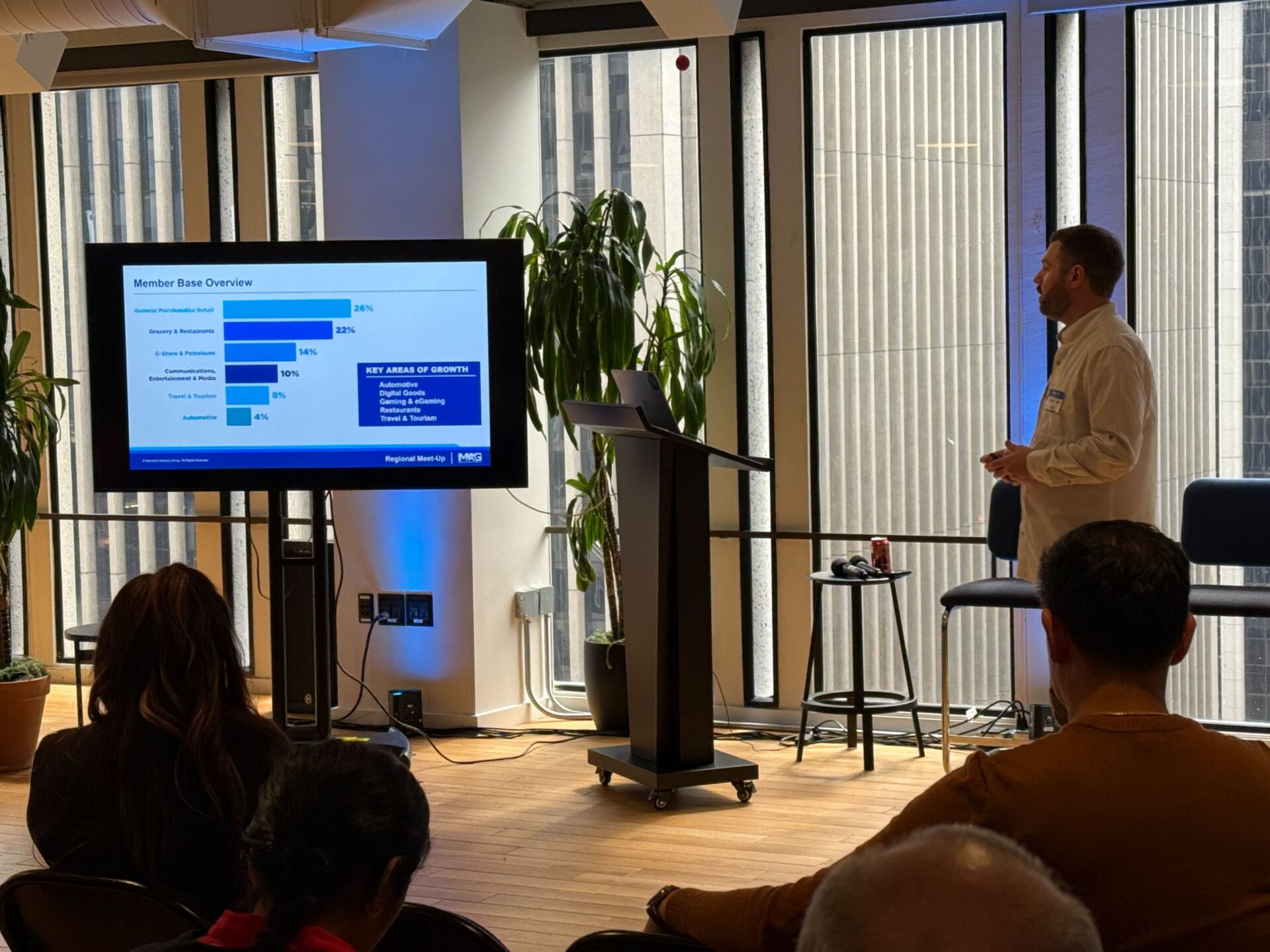
]]>This October, merchants from across the Bay Area gathered at WeWork Embarcadero for the MAG | Sift San Francisco Merchant Meet-Up—an afternoon of practical insight and open discussion about the state of fraud in digital commerce.
Hosted with the Merchant Advisory Group (MAG), the event gave peers space to explore what’s next in digital risk and payments—and how fraud and payments teams now balance risk management with revenue growth.
1. Agentic AI Grounded in Outcomes Can Deliver Real Value
Agentic AI (systems that plan and act toward goals autonomously) drove the most discussion. Many merchants are already testing it to automate chargeback documentation, streamline refund reviews, or route transactions based on risk.
The consensus: agentic AI isn’t a cure-all. Projects that don’t deliver measurable ROI fade quickly. In other words, if it doesn’t move approval rates or reduce headcount hours, it doesn’t stick. The sentiment mirrors analyst caution: Gartner projects that more than 40% of agentic AI initiatives will be abandoned by 2027 for failing to deliver results.
The takeaway is to start small and stay measurable. Even modest efficiency gains can validate impact faster than broad pilots. The merchants seeing results embed human oversight, maintain audit trails, and benchmark every use case against fraud and finance KPIs.
2. Passkeys Are Moving from Promise to Practice
Everyone agreed: passwords are collapsing under their own weight. Credential stuffing and phishing continue to drive account takeover (ATO), pushing merchants toward phishing-resistant authentication.
According to the FIDO Alliance, 87% of companies in the U.S. and U.K. are piloting or deploying passkeys, and NIST’s latest Digital Identity Guidelines endorse them as a best practice.
Merchants are taking practical steps, like enabling passkeys for returning customers, binding trusted devices, and focusing on mobile logins where UX is strongest.
When paired with adaptive risk checks like device fingerprinting, passkeys help block fraudsters without adding friction for trusted users. Authentication is becoming a conversion opportunity, not a compliance task.
3. Account Takeover is a Risk and Revenue Problem
The most urgent discussion centered on ATO, reframed as a frontline revenue issue. The FTC reported $12.5 billion in consumer fraud losses in 2024, with ATO a major driver. Beyond direct loss, every compromised account erodes lifetime value, inflates acquisition costs, and corrupts risk models.
Leading merchants now track ATO alongside chargebacks and false declines, and link fraud metrics to loyalty and retention. Progress comes from identity resolution across the customer journey, from sign-up to transaction to rewards. Fraud, payments, and loyalty teams are converging on shared goals: less friction, higher approval rates, and durable customer trust.
Trust is the New Growth
Fraud and payments teams no longer sit at the edge of the customer journey—they are the journey. Every decision is a revenue decision.
The merchants leading this charge are operationalizing trust by measuring it, automating it, and aligning it with financial outcomes. Agentic AI, passkeys, and ATO mitigation aren’t abstract technology debates; they’re growth engines that shape experience and secure advantage.
Trust drives revenue. Those who operationalize it now will define the future of digital commerce.


Explore how these trends intersect in Sift’s latest Digital Trust Index, examining account takeover in the era of agentic AI.
The post 3 Themes from the MAG-Sift Merchant Meet-Up: Agents, Passkeys, and Identity Trust appeared first on Sift.
]]>Q3 was an eventful quarter for Sift, with repeat industry recognition, new product innovations, and fresh insights from our network on how AI is shaping fraud. We launched tools that make fraud management simpler and smarter, uncovered new data on account takeover trends, and connected with merchants across the industry to talk about what’s next […]
The post Q3 2025 in Review: Sift’s Wins, Innovations, and Fraud Insights appeared first on Sift.
]]>Q3 was an eventful quarter for Sift, with repeat industry recognition, new product innovations, and fresh insights from our network on how AI is shaping fraud. We launched tools that make fraud management simpler and smarter, uncovered new data on account takeover trends, and connected with merchants across the industry to talk about what’s next for digital trust.
In this roundup, we’re sharing the top highlights from Q3 2025 and a look at how Sift continues to help businesses stay one step ahead of fraud.
Sift Maintains #1 Position Across All Fraud Prevention Categories in G2’s Fall 2025 Reports
Sift continues its dominance in G2’s latest Grid Reports, maintaining the #1 ranking across all fraud-related categories for the second consecutive quarter. Sift secured the top position in G2’s Fall Grid Reports for Fraud Detection, E-Commerce Fraud Protection, and Risk-Based Authentication (RBA). G2 is the world’s largest and most trusted software marketplace and Sift’s recognition is based on reviews from over 550 verified Sift users.
“We consistently utilize Sift in our daily investigations. As risk investigators, Sift has become an essential part of our assessments. It guides us in decision-making by providing valuable insights such as login activities, locations and devices used, and other online behaviors of customers. The tool is user-friendly and seamlessly integrates with our other systems for conducting checks. Our Customer Support team also relies on this tool. The ease of implementation of Sift helps us work more efficiently.”
Read the announcement or check out Sift on G2.
Sift’s Fall ’25 Release: Advanced Fraud Investigation Tooling to Simplify Fraud Management & Strengthen Identity Trust
Our Fall ’25 release advances the way businesses detect and evaluate risk, without adding complexity to the work. Combining pre-built workflows, advanced policy abuse protection, and deeper investigative visibility, these innovations allow for faster defense deployment, sharper threat detection, and revenue protection without customer friction.
- Pre-Built Workflow Templates: Delivered through Sift’s award-winning user interface, Pre-Built Workflow Templates provide fraud teams with immediate access to industry-specific templates for preventing payment fraud.
- Incentive Abuse Tools: By leveraging policy rules to detect loyalty, promo, and referral abuse before a transaction occurs and revenue is at risk, Specialized Console Functionality for Incentive Abuse allows businesses to block first-party fraud and fake account creation while helping to lower customer acquisition cost (CAC).
- Expanded Investigation & Reporting: Three additional upgrades (Global Identity Search Filters, ATO Overview Dashboard, and Historical Chargeback Import) give fraud teams deeper context and clearer visibility into high-risk activity.
Read more about these innovations.
New Data on Account Takeovers in the Era of Agentic AI
The Q3 2025 Digital Trust Index, powered by FIBR (the Fraud Industry Benchmarking Resource), uncovers how account takeover (ATO) fraud is accelerating in the era of AI. Fraudsters are leveraging agentic AI, bots, and fraud-as-a-service tools to launch faster, more targeted ATO attacks, driving up losses and eroding customer trust. The report reveals where ATO is rising across industries, a widening risk gap between generations, and how AI-driven identity signals can stop attacks before they succeed. Key insights include:
- ATO fraud is accelerating and hitting high-value targets: ATO attacks rose 4% YoY across Sift’s network, with fintech & finance up 122%, travel & ticketing up 56%, and internet & software up 17%. Fraudsters are using bots, infostealer malware, and AI-driven credential stuffing to scale attacks.
- ATO quickly erodes customer trust: Fourteen percent of consumers were hit by ATO in the past year, mostly on social (51%) and subscription (33%) accounts. After an ATO, 75% would stop using the site and 87% would warn others, holding businesses responsible when protections fail.
- Agentic AI Accelerates Account Takeovers: Fraudsters are using autonomous AI agents to automate key steps of ATO, cutting the time to hijack accounts in half. Combined with fraud-as-a-service tools, these agents democratize fraud, enabling scams to scale faster and making detection more difficult.
Partnering with the Merchant Advisory Group
At this year’s MAG Payments Conference, one theme was impossible to miss: AI is no longer just a tool, it’s becoming the operating system of modern commerce. In an interview with conference emcee Rachel Sheerin, Sift CMO Armen Najarian shares how AI-driven decisioning is helping businesses move beyond fraud defense and reframe risk as a driver of sustainable growth.
Watch the interview from MAG San Antonio.
We also hosted the MAG | Sift San Francisco Merchant Meet-Up earlier this October, which gathered merchants from across the Bay Area for an afternoon of practical insight and open discussion about the state of fraud in digital commerce. The event gave peers space to explore what’s next in digital risk and payments, and evaluate how fraud and payments teams now balance risk management with revenue growth.
See our top takeaways from the event.
For daily fraud insights, follow Sift on LinkedIn.
The post Q3 2025 in Review: Sift’s Wins, Innovations, and Fraud Insights appeared first on Sift.
]]>