Except maybe dungeon crawlers, few genres seem to attract game designers like trains. Now, Paul Dennen, designer of GeekDad Game of the Year Dune Imperium and GeekDad Game of the Year finalist Clank is bringing his spin to train building games with Lightning Train.
What Is Lightning Train?
Lightning Train is a game for 1-4 players, ages 10 and up, and takes about 120 minutes to play. It’s currently available at your friendly neighborhood game store or other fine retailer.
Lighning Train was designed by Paul Dennen and published by Dire Wolf Games, with illustrations by Clay Brooks, Derek Herig, Kenan Jackson, and Raul Ramos.
Lightning Train Components
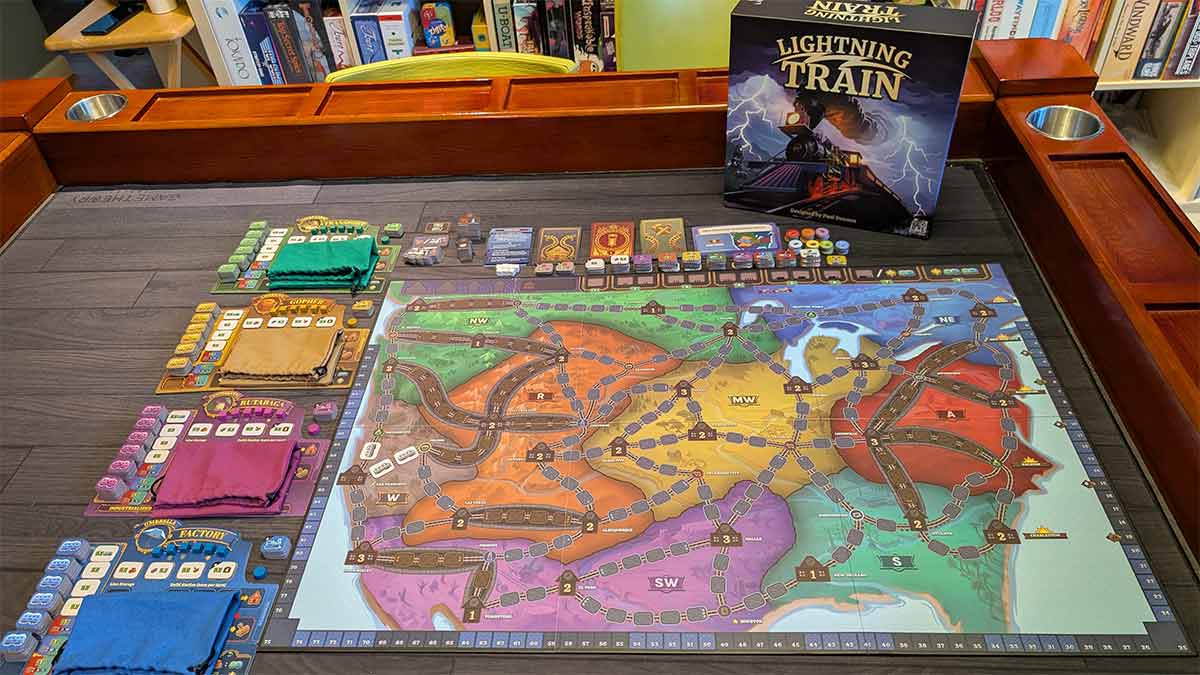
Inside the box, you’ll find:
1 double-sided board
1 Lightning Train market token
7 neutral station markers
84 market chips
42 goods tokens (6 each in 7 categories)
8 loan chips
27 station tokens (15 large, 12 small)
6 delivery tokens
2 delivery/contract tokens
6 $1 + chips
25 mogul cards
20 action cards
15 production cards
10 setup cards
4 sets of player components, 1 in each of 5 colors:
- Company board
- Go Public board
- Industrialize board
- Score marker
- 6 station markers
- Company bag
- 48 basic trains
- 6 locomotives
- Helper card
- 4 power chips
- 7 starting chips
In addition, there are some components for the solo and 2 player game:
- Die
- Rival turns helper card
- 4 builder tokens
- 8 region cards
- 2 dynamite tokens
Dire Wolf has been making really nice games for some time now, so you’d expect great components, and Lightning Train doesn’t disappoint.
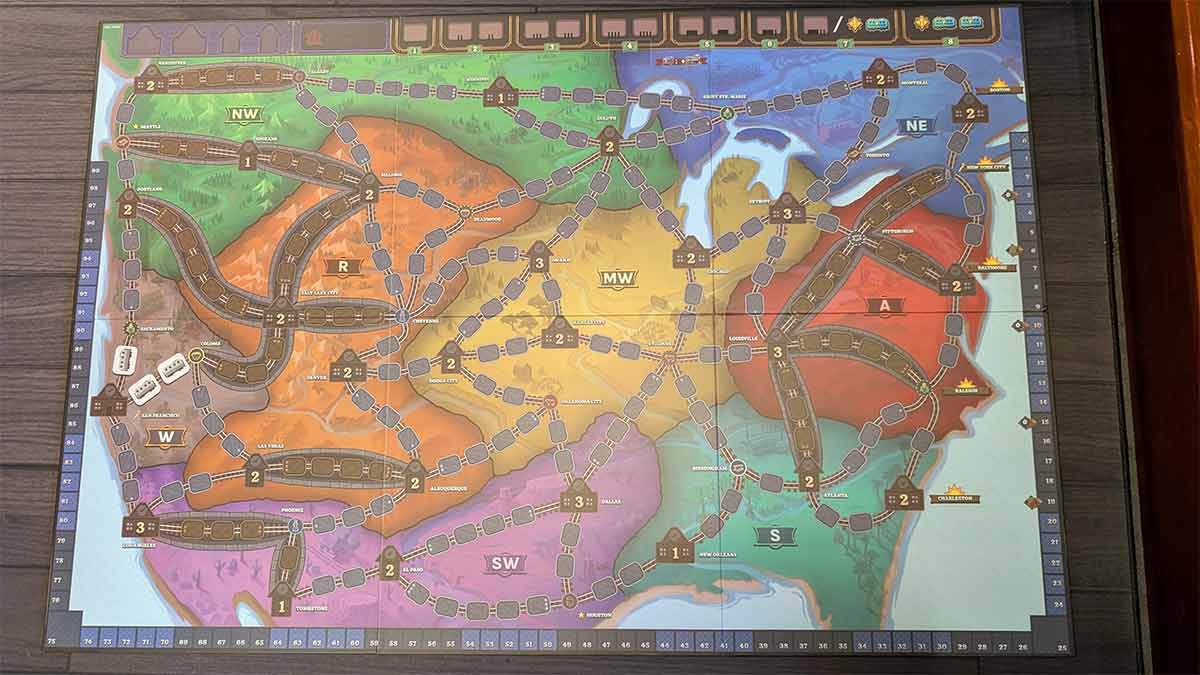
The board is basically a map of the US and southern Canada. Well, sort of. If you’re familiar with Ticket to Ride, you’ll know that they had to occasionally take liberties with geography to get things to fit. Lightning Train does as well, but at a whole different level. I’ll just say that if you’re a geography nerd, this board is going to drive you crazy. Still, the layout they made works, and it nicely fits all of the components, which in the end was (rightfully, I think) the right choice. Similar to Ticket to Ride, the board primarily shows the routes between cities on which you’ll build your train routes. Unlike TTR (and I should mention here that there are enough similarities in the games that anyone who has ever played TTR is going to immediately make all kinds of connections, and that definitely applies to me) there is only a single route between cities, and since building routes is only one of several things you can do in this game, the board also includes icons for stations, for placing goods to be delivered, for routes through mountains, and much more.

The aforementioned goods to be delivered are represented by small round cardboard tokens, simply illustrated with the good.

The station tokens come in two sizes, small and large, both die-cut cardboard to fit the spaces indicate on the map. Each has an illustration of an old train station on one side, and either one or two goods that the station needs on the other.
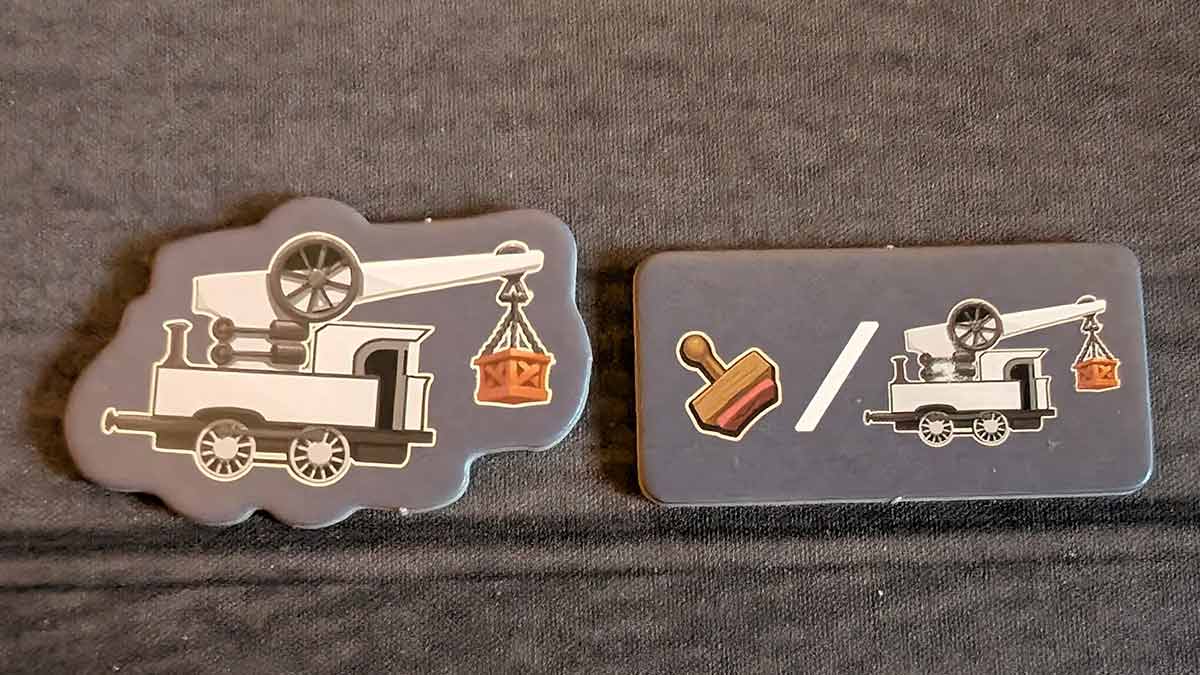
The 6 delivery and 2 delivery/contract tokens are used as a way to help all players early in the game, and to give a slight advantage to the third and fourth player to offset going last. They are, like most of the rest of the components, double-sided cardboard.
What truly makes Lightning Train unique is that it takes two of the most common elements of train games–markets and rail lines–and combines them in to one. But it also adds in a bag building element, so most of the rest of the cardboard tokens are all identically-sized rectangular tokens that can be added to and drawn from the player bags.
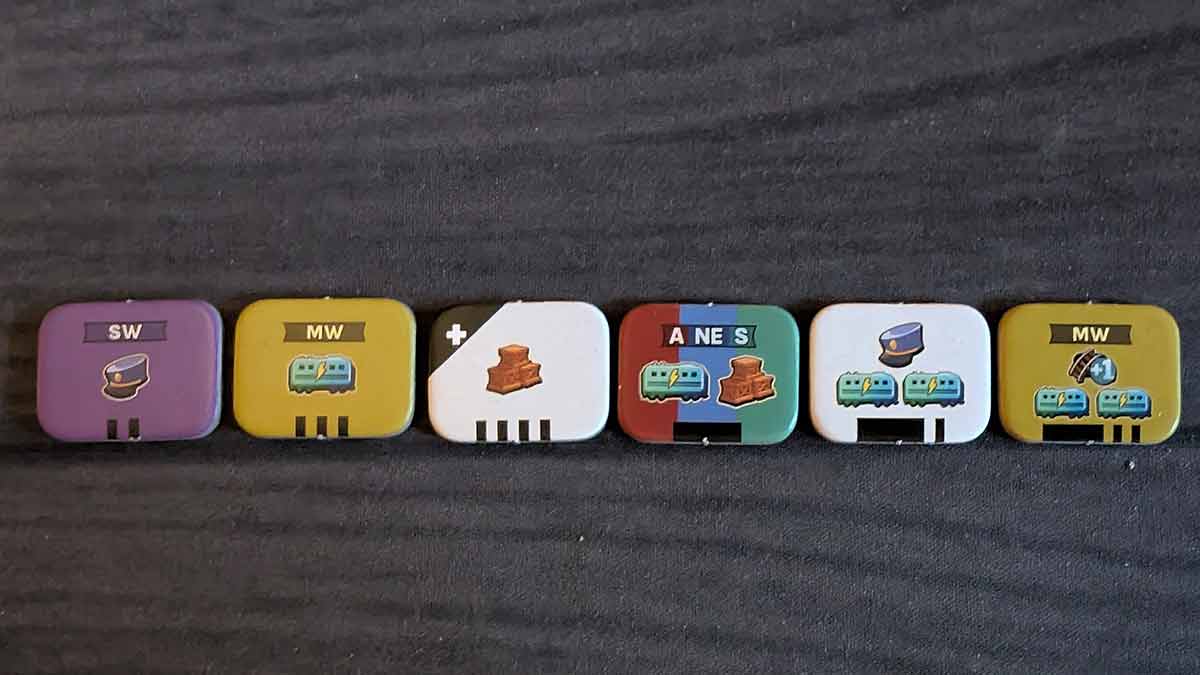
The biggest set of these for shared use by all players are the market tokens. These display some kind of benefit or power to be used in the game (I’ll get into detail on that below) and also a somewhat unique pricing system. The market row at the top of the board has spaces for tokens of differing values, and black lines indicating the cost: 2 through 8. But, they aren’t simply long sets of lines that woud require counting. Instead, the two, three, and four-cost tokens (and matching space on the board) have sets of lines, but the 5-cost one is instead one solid block. The six adds a line to that block, as does the seven. (The one and eight-cost spots are special, but we’ll get to that.) This is a rather brilliant system that makes it easy to know the cost of these blocks at a very quick glance.
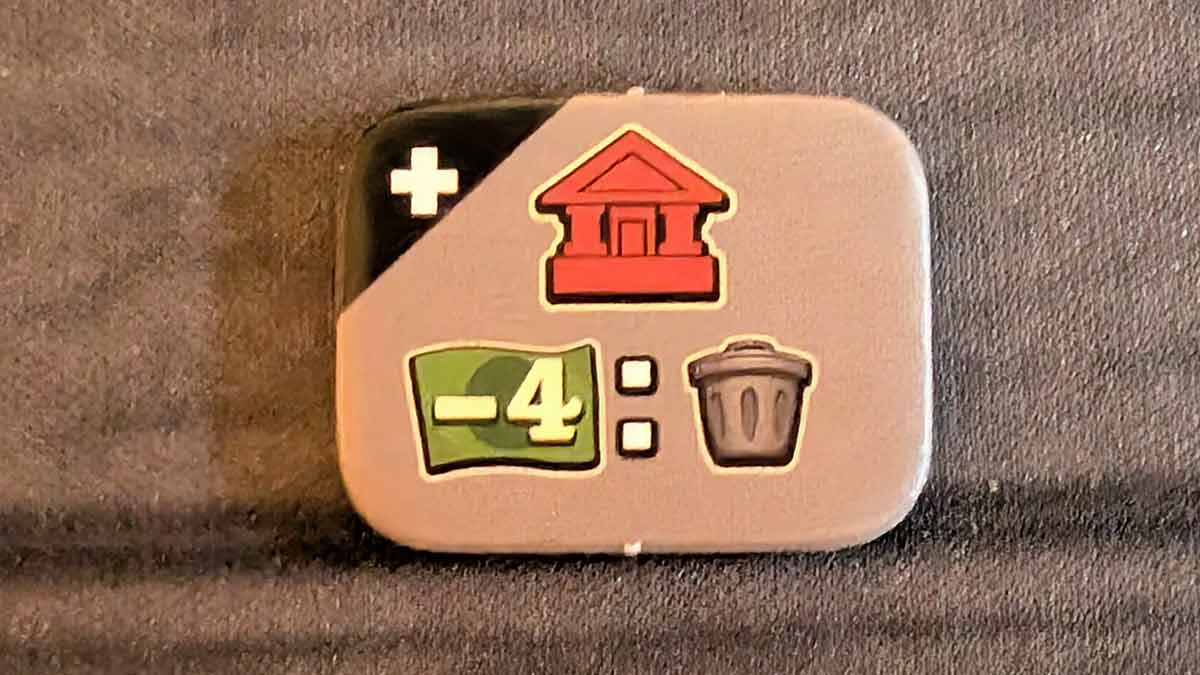
Of the same size are the bank loan chips and the $1 + chips.
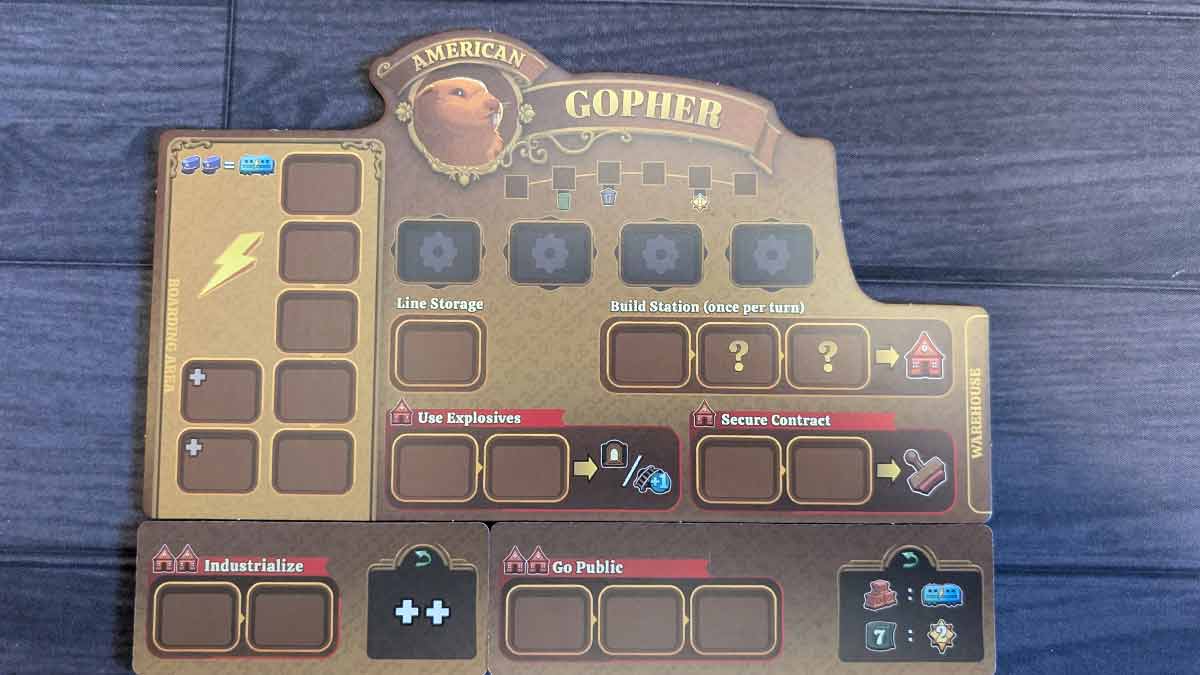
The player components consist of a heavy cardboard, single-layer player board with two additional upgrade boards that fit below it. Both of these–industrialization and going public–have spaces on one side to build those upgrades and then a reverse side to show what happens when players upgrade.

There’s a wooden score marker and six wooden cubes for marking stations.

Again, one of the game’s main mechanics is bag building, so of course there’s a cloth bag for each player.

Each player also needs train cards to build those routes. They get 48 basic trains (that look like passenger cards) and 6 locomotives. These are cardboard tokens of the same size and shape as the market tokens.
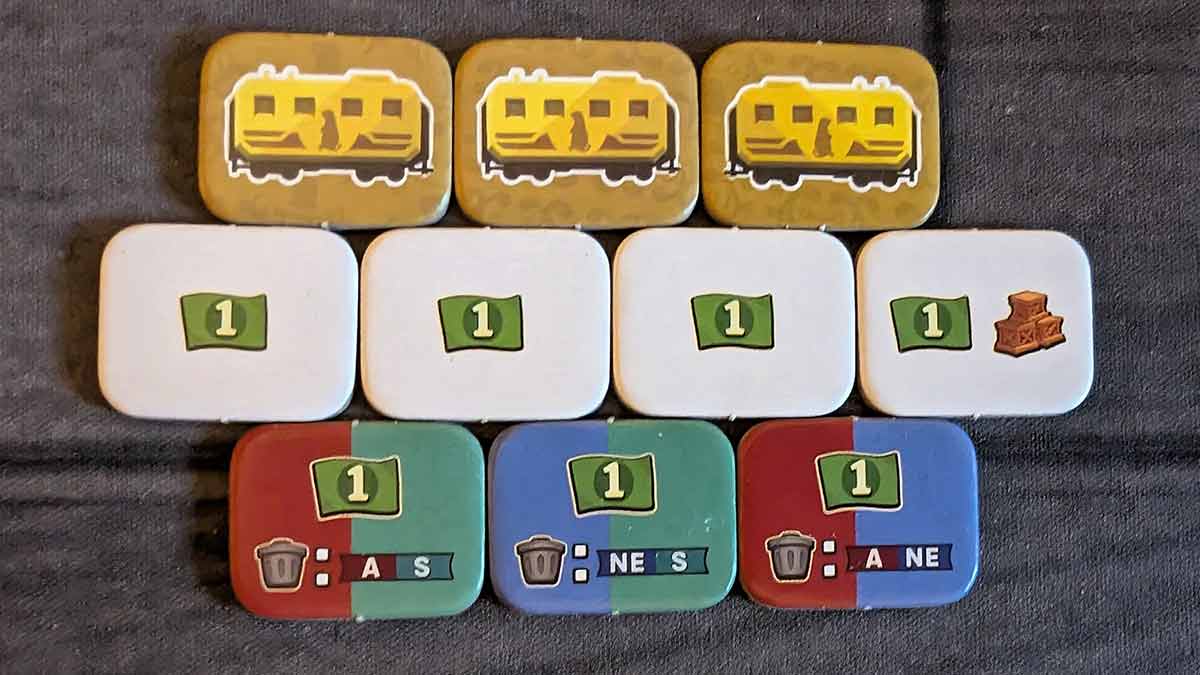
Every bag builder needs a starting set of tokens. Here. that’s represented by three market tokens and four $1 tokens. Players also put three train tokens in their starting bag.
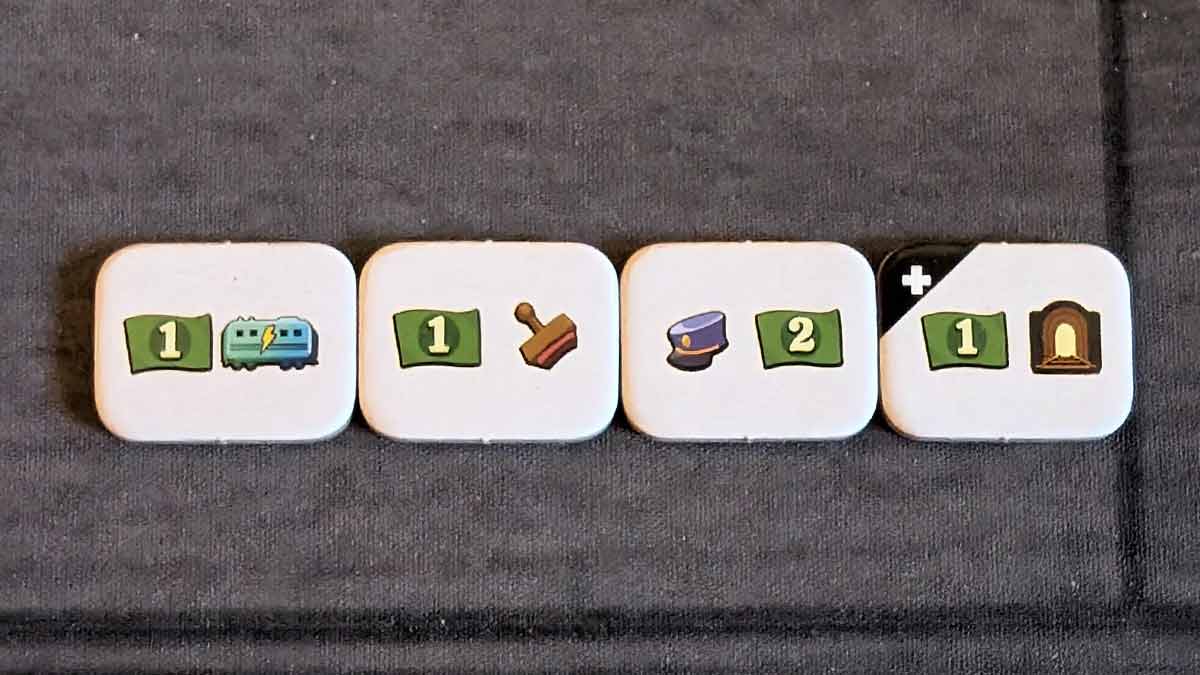
The final player components are the power or upgrade chips that players can earn as they score points.
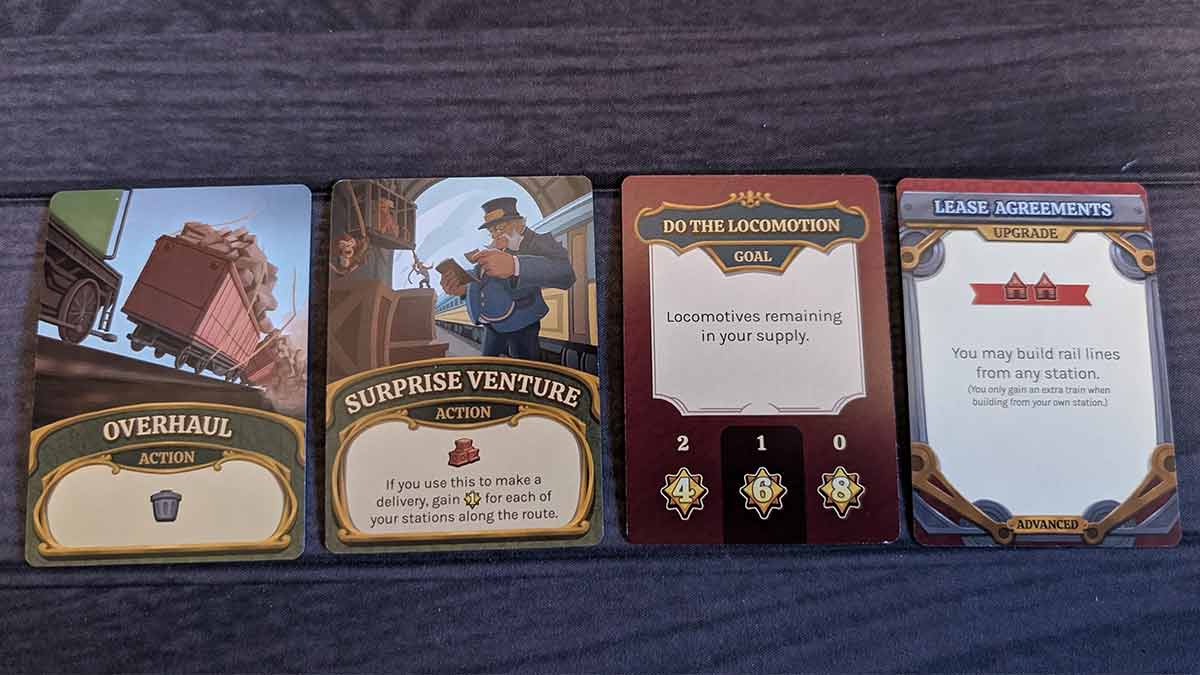
Then, there are the cards. This isn’t a card game, and there are a fairly small set of cards in the game, divided into four decks. The first is a set of 25 mogul cards, which are a combination of end-game goals and one-time upgrades. The second deck is made up of 20 action cards, which are mostly things that players will draw and use right away, although a few are more useful to hang onto. The opportunities to draw from either of these decks are rare, so players are likely to see no more than a few of the cards from either deck.
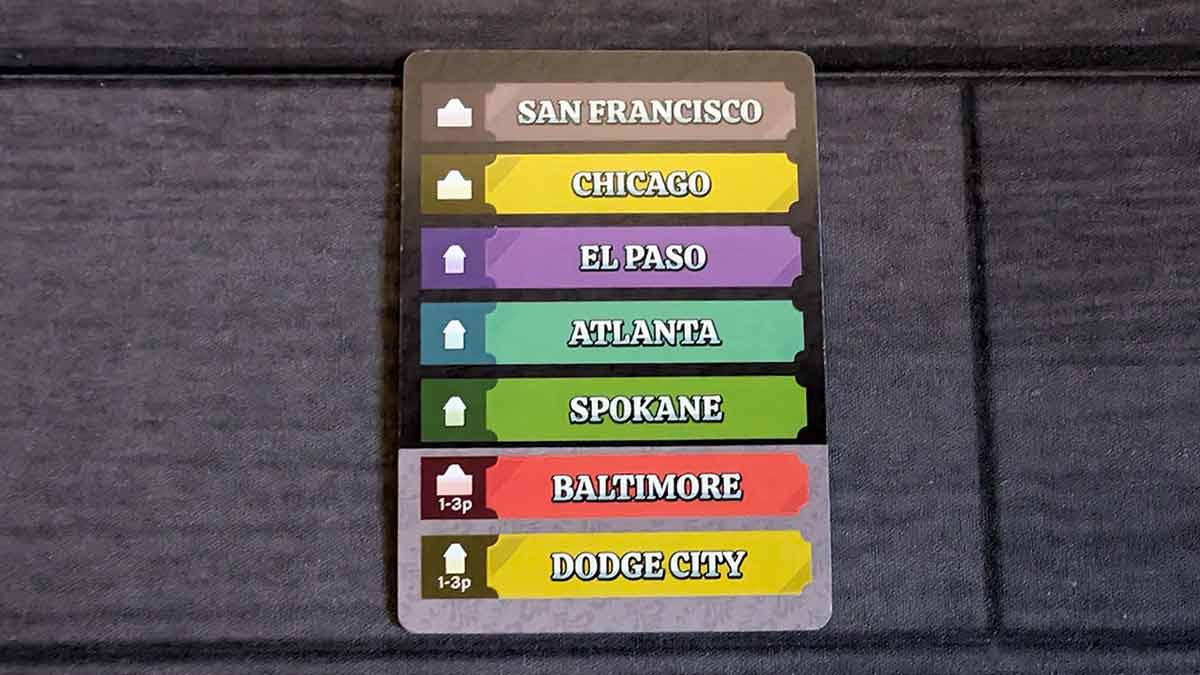
The third deck is for setup: at the start of the game, San Francisco and a set of semi-random other cities get a neutral station as a jumping-off point for building.
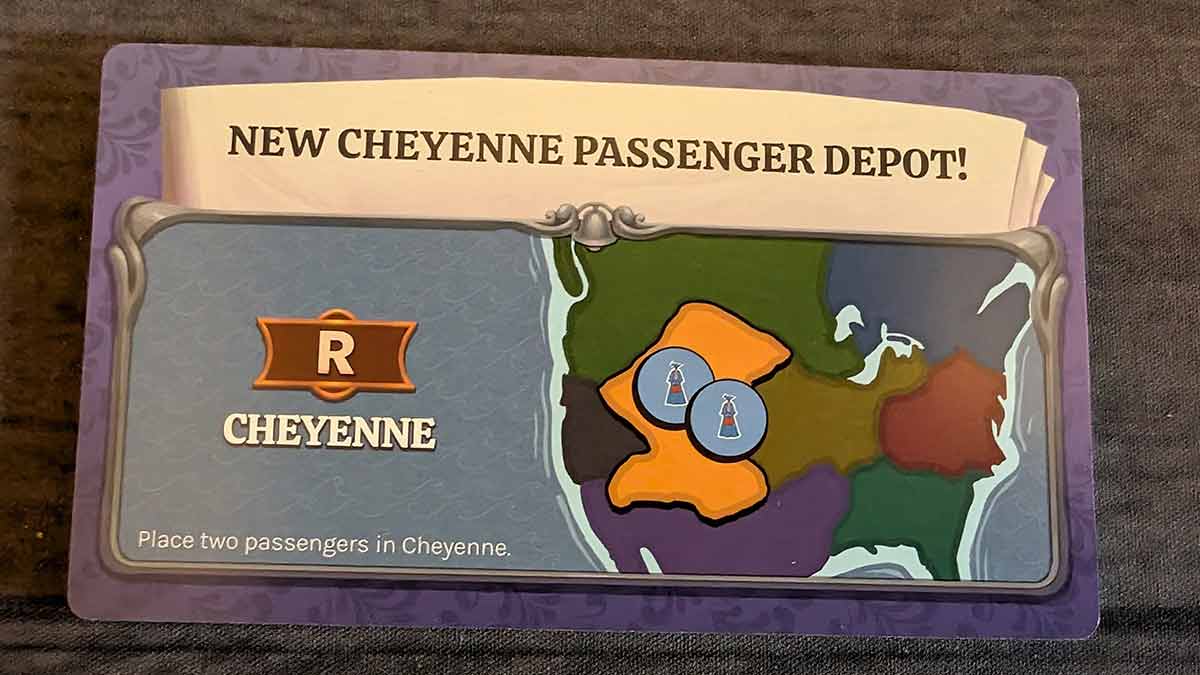
Finally, there’s a larger deck (all of the other cards are poker-sized) of 15 production cards, which are used to track the rounds in the game and add resources to the board.
There are also a set of components used exclusively for a solo and 2-player game.
How to Play Lightning Train
You can download a copy of the rulebook here.
The Goal
The goal of the game is to score the most points when the game ends. Points are mostly earned by building trains and delivering goods, but there are also end-game goal cards and some chips that give you points as well.
Setup
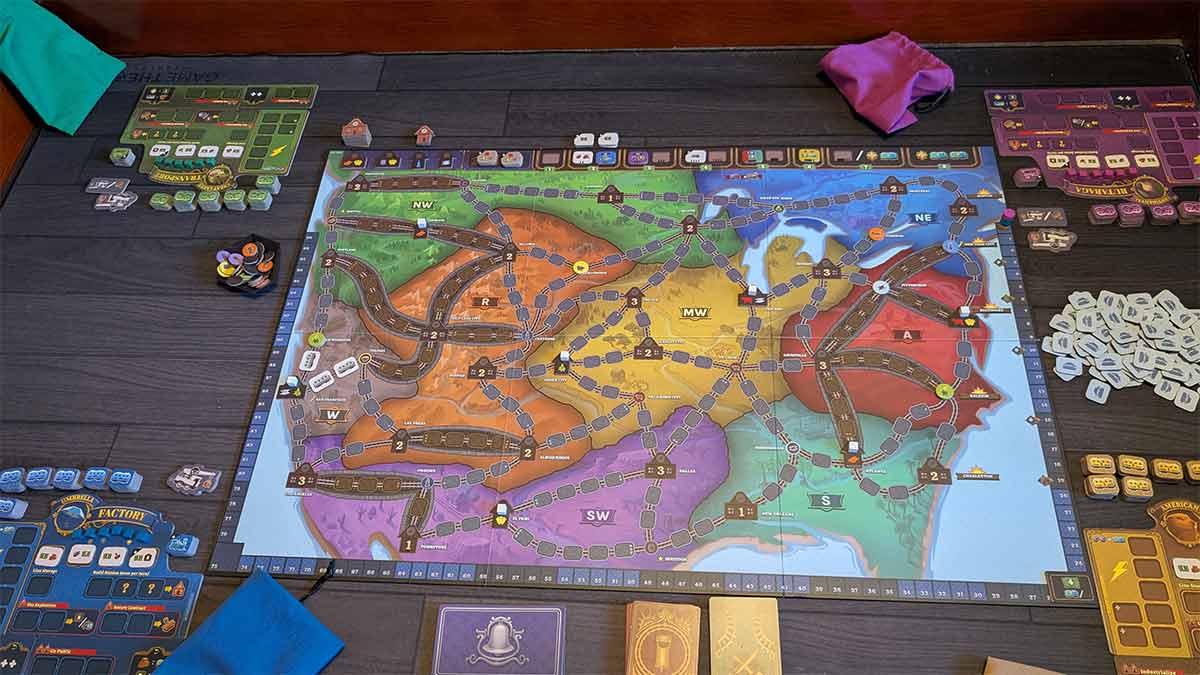
Lay the board out on the table. Make sure you have the side that matches the number of players: there’s a side for 1-2 player games, and a side for 3-4, indicated in the upper left corner. Place the Lightning Market token on space 25 of the scoring track (the lower right corner.)
Place two goods tokens on each city marked with dashed lines–Sacramento, Deadwood, St. Louis, Toronto, New York City, Pittsburgh, and Raleigh. The proper goods for each city is indicated on the board.
Create a supply of market chips by flipping them upside down and shuffling them. Then, stock the market by drawing six chips, one at a time, and placing them on the market on the spaces indicated by their cost. If a particular market space is full (each price, except 1, has space for two chips), set the extra one aside and draw a new one, then put the extra bag in the supply when finished. Stack the six $1 + chips above the 2 space. Place the loan chips in the bank to the left of the market.
Shuffle the startup deck and draw a card, then place neutral stations on each of the 7 cities indicated. Place a white cube on each station as a reminder that they are neutral. (Note that San Francisco will always be a neutral station.) In a four player game, you’ll only plave 5 cities, ignoring the last two on the card. Return all of the startup cards to the box as they will not be needed again.
Sort the remaining stations by size. Place two large and two small stations face-up on the indicated spaces in the top left corner of the board, then put the rest of the stations in a supply nearby.
Separately shuffle the action deck and the mogul deck. (It’s recommended that you first remove the “advanced” cards from the mogul deck if you’re new to the game.) Deal two mogul cards to each player, then put both decks face-down near the board.
Give each player all of the supplies of their color, along with a reference card. Players should place their board near them, with the industrialize and going public boards below the main board. They will place all five of their bonus chips in the spaces at the top of their board, and all 6 station marker cubes in the spaces indicated. They should make a supply of trains and engines near them, keeping them separated. Place the scoring marker on the zero space.
Then, they can set up their bag: place three trains (not locomotives), the three starting contracts, and the four starting money chips in their bags. Each player then shakes their bag and draws five chips and places them in the spaces on the boarding area on their player board. If they draw all three of their starting contracts, or none of them, they should return all of the chips to the bag and draw again. Repeat as needed until the starting set has either one or two, but not zero or three, starting contracts. If they draw the chip with the dollar sign and the lightning train, they will place one train in the boarding area as well.
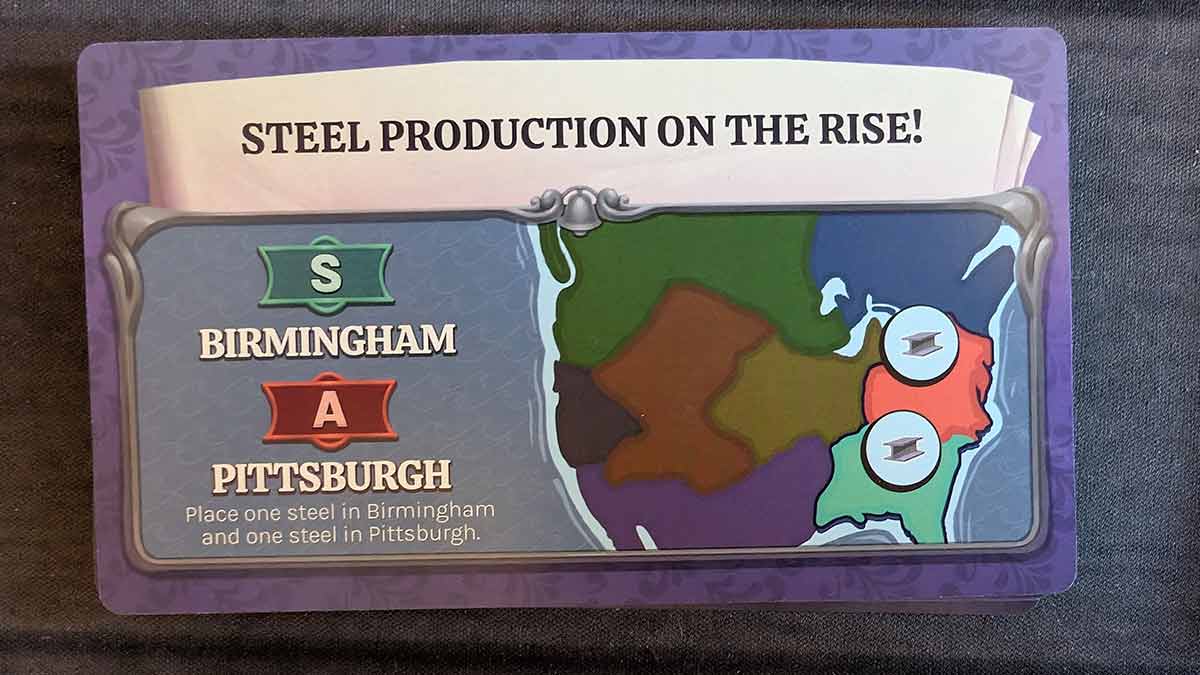
Finally, the starting player (determined randomly) takes the production deck, shuffles it, and then selects three cards and returns them to the box without looking at them. They then draw the first card. They should place additional goods on the board according to the card that is drawn. (One card does not place goods.) They will remain the starting player throughout the game.
The first and second player in turn order receive two delivery tokens. The third and fourth player receive one delivery token and one delivery/contract token each.
Gameplay

The game is played over a number of rounds. At the start of the first player’s turn, they draw a production card and place the indicated resources on the board. Then, for all rounds except the first, they check for the “award subsidies”, a catch-up mechanic that awards lightning trains to players who are falling behind on the score track. That track is divided into zones of five spots. For each complete zone between the player in the lead and other players, those trailing players get a free train to be added to their boarding area this round. Note that they can be awarded a maximum of two trains.
Each player then takes their turn by first completing an operations phase, and then a turnover phase.
In the operations phase, players spend their trains and money to perform any number of actions. Possible actions are:
- Build a rail line
- Make a delivery
- Assign trains to the railyard
- Take railyard actions
- Play action or upgrade cards
- Spend money
- Perform other chip actions.
Players can perform as many of these actions as they can afford, including taking the same action more than once. They can also perform the actions in any order.
Build a Rail Line
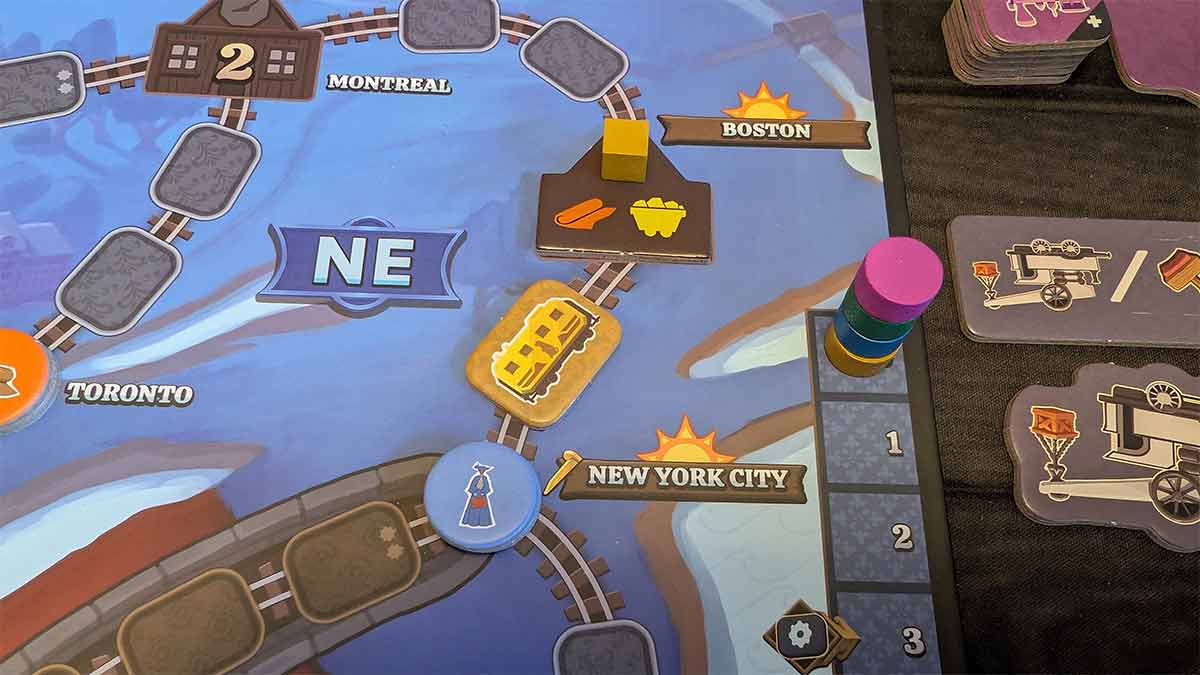
At its heart, Lightning Train is still about building train lines. Players may build lines between cities by playing the appropriate number of trains from their boarding area to the board. But, there are a few key limitations.
You may only build one rail line per turn, unless you use a special action that gives you more builds.
First, you must have a contract for the region in which you’re building. If the line in question passed from one region to another, you need a contract for either region (but not both.)
Second, you must be able to build the entire line in one turn. For example, the line between Pittsburgh and Louisville has three spaces, so three trains must be played at once there. (Yes, exactly like in Ticket to Ride.)
Third, you must build the line either from one of the starting cities (the cities marked with suns on the East Coast), or to extend one of your existing lines, or from a station you own.
Fourth, if the line is a mountain path–the lines with bricks along them–you must also be able to tunnel, either by having a chip or action card with the tunnel icon, or by using explosives.
Many, but not all, of the routes have star icons on each end. If you build one of these routes, you earn the number of points indicated.
One last thing: if you are building from one of your stations, you gain a bonus by being able to play one train from your supply to use on the line, thus reducing the cost of that line by one. If you happen to have a station on one of the one-train lines, you can build for free. However, you only get one bonus train, so if you’re connecting two of your stations, you don’t get two free trains.
Honestly, the first requirement is always going to be a struggle. You must always have a contract for the region before you build, even if you already have a station there. This is the biggest limiting factor in building lines.
Make a Delivery
All of the cities on the board that aren’t station spaces have goods. Many of them won’t actually get goods until later in the game–remember that each round starts by drawing a production card that places more goods on the board. Stations, on the other hand, have either one or two icons indicating the type of good that station needs. Making a delivery is simply that: taking goods from a city and delivering them to a station. You can make any number of deliveries per turn, but in order to do so you must have a Venture icon–it looks like three stacked crates–on a chip in your boarding area or an action card (and each icon only allows you to make a single delivery), or you need to spend (i.e., discard from the game) one of the delivery tokens you got at the start of the game.
You can also only make deliveries along completed train lines, although they don’t have to be entirely your own. To make a delivery, simply pick up the chip from the city space and move it along the connected raillines. The owner of each line scores one point, and the owner of the station at the end scores one point as well.
One other limitation: if you have a choice between lines to use, you must use the shortest line–the one with the fewest number of lines (not trains). This means that while you can pick up a chip from one end of the map and deliver it to the other, you cannot chose to use your own lines if others have built a line that is shorter. If there’s a tie–if you and another player have equal lines–then you have to use the one that contains the most locomotives (we’ll talk about locomotives later.)
Once you get to the intended station, you will flip the token facedown and use it to cover the goods icon on the station. Each station can only receive a delivery of a particular good once.
Neutral stations can also accept deliveries, the only differing being that no one scores the point for the station. In addition, there are two lines coming out of San Francisco–one to Coloma†, and the other to Sacramento‡, that can be used for deliveries but again, do not score points for those lines.
† Coloma is where, in 1848, gold was discovered on the American River, sparking the California Gold Rush and, by extension, the drive to build the Transcontinental Railroad. Since both of my kids grew up in the Sacramento region, Coloma is a standard fourth-grade field trip destination, so I’ve been there a few times. There’s a nice little museum about the discovery, but one thing that was not, and to this day still is not, in Coloma, is a railroad. It is, after all, on the American River.
‡ As a long-time resident of Sacramento, I do take a minor bit of offense to the game’s insistence that the western terminus of the Transcontinental Railroad was San Francisco. Depending on how you want to count it, the western end of the line was either the Oakland Long Wharf or Sacramento. Either way, it most definitely was not San Franciso. If you’re ever in Sacramento, you should make a point of visiting the California State Railroad Museum, considered to be one of the finest train museums in the world. While there, you’ll be able to see one of the actual golden spikes that was used at the completion of the railroad at Promontory Summit in Utah on May 10, 1869.
Assign Trains to Your Railyard
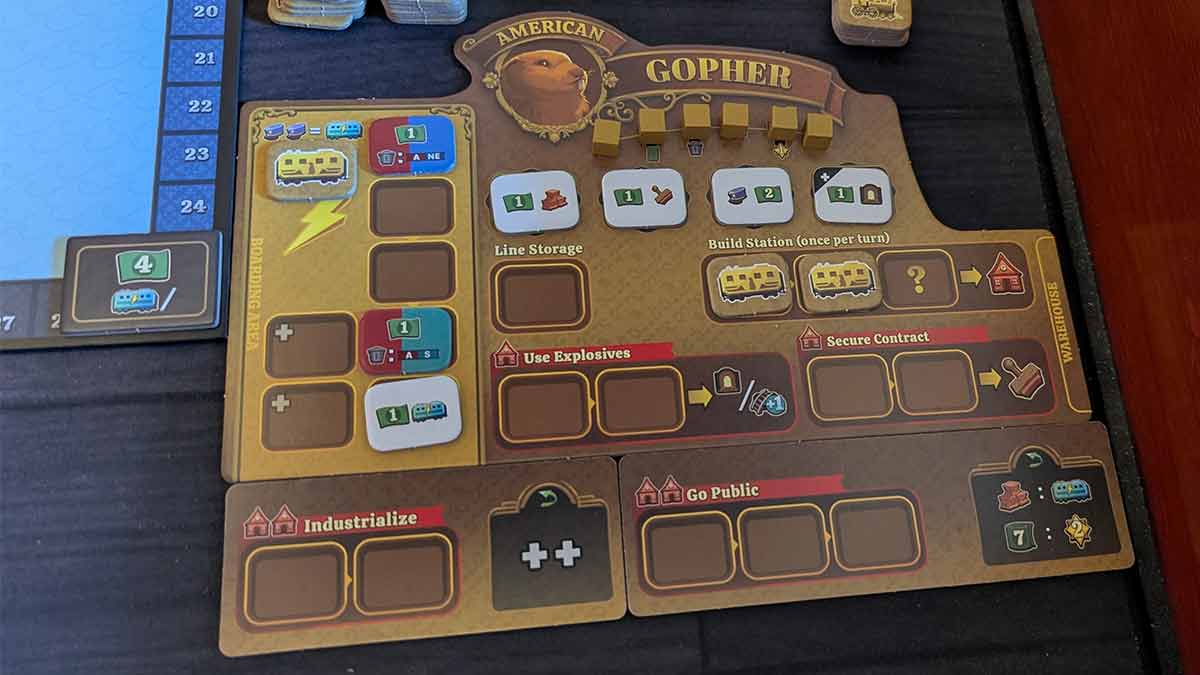
The main part of the player board is the railyard. Here, you can assign trains to use either in this turn or in future turns to perform actions.
The Line Storage space lets you park a train–either a regular train or a locomotive—to use in a future Build a Rail Line action. Note that a train can be parked here for any number of turns, but when used, it can only be used to build a line.
Build Station allows you to, well, build a station. Every station space on the board has a cost of one, two, or three trains. Depending on the station you want to build, you can put the appropriate number of trains in these spots, then move them to your warehouse–the area to the right of your player board–and place a station there. As with building a rail line, you must have a contract matching the region in which you wish to build before you can perform this action. Take the left-most cube from your board and place it on the station.
Note that as you have six cubes on your board with which to claim stations, so you are limited to six stations. In addition, the second station that you build allows you to draw a card from the action (green) deck. The third station allows you to trash any token in your boarding area or warehouse. And the fifth station lets you gain a point.
(Strategy chip: on the turn on which you are going to build your third station, take a loan before building the station, Then, when you build the station, you can trash any chip in your boarding area or warehouse, which is where the loan will be. This is one way you can in essence get a free loan.)
I should mention here that all three of the starting contracts are of somewhat limited use. You’ll find that the stations and routes on the East Coast fill up quickly. Thus, these all have a built-in mechanic to keep them from polluting your bag: once used, these three tiles are immediately trashed. There are other ways to get contracts, so losing these tiles after their first use really is a good thing.
Secure Contract allows you to claim a contract on any region of the board, regardless of your chips. You’ll find that getting contracts is the number one thing that will limit your ambitions, so taking this action is very helpful. However, there is one limiting factor: you must have built at least one station in order to place trains here or use this action. Note that when you use this action, you earn a contract in that region for the entire rest of your turn, so you can as many build stations and rail lines as you want.
Use Explosives also requires that at least one station has been built, and it allows you to choose one of two actions. You can either take a second build action (remember that you are otherwise limited to a single build action per turn) or you can gain the tunnel effect, which lets you build on those mountain paths.
Note that with all of the above, you can park trains on these spaces. So, if you only have a single train left to use, you can simply place it on, say, the build station space. On subsequent turns, you can then add to them. But even when they fill up, you don’t have to use them right away.
Also, when you take any of these actions, you move the trains you’re spending to your warehouse. That clears those spaces, and they can be used again this turn. For example, if you had enough trains, you could put two on the Use Explosives spot to gain the tunnel action, move those trains to your warehouse, then put two more trains down to gain the construction action and build on a mountain line (assuming, of course, that you have enough trains to do that.)
The final two places to use trains in your railyard are the two upgrade boards at the bottom. Industrialize gains you two additional + spaces, which in essence let you draw more tiles (see the description of the Turnover phase below.) You must have two stations on the board to place trains here, and it costs two trains, but once you do this you flip the board over to gain those spaces.
Going Public likewise requires two stations, and it costs three trains. Once you spend them and flip the board, you gain two permenant effects for the rest of the game. One is that every time you draw a tile with the Venture icon (the stacked crates), you immediately gain a lightning train. (You also gain this effect immediately when you first flip the board over.) The second is that you will gain two points every time your tiles generate 7 or more dollars.
Play Action and Upgrade Cards
Action cards generally provide you with one-time benefits. They can be played, and the benefit earned, at any point in any turn. They are then discarded.
Mogul cards give you either some kind of upgrade–an ongoing, permenant benefit from the moment you play the card–or end-game points (basically, an end-game goal.) You have two of these cards from the start, and there’s no real reason not to play upgrades as soon as you can (note that some upgrades have a minimum number of stations before they can be played.) End-game bonus cards are held in your hand until the end of the game.
There are very few points in the game where you actually get to draw a card, so use the few you have to your benefit. When you reach 19 points, you will be able to draw a new card from either deck and then discard a card, so while there’s no penalty for having a useless card in your hand at the end of the game, you will have a chance to dump one during the game.
Spend Money
Lighnting Train is a bag building game, and the way you buy more chips to add to your bag is by spending the money you earn each round. The market will always have exactly six chips out, and you can buy any or all that you can afford. Any money you don’t spend on a turn is lost. If you trash a chip because of an effect during the turn, you still get the money from it.
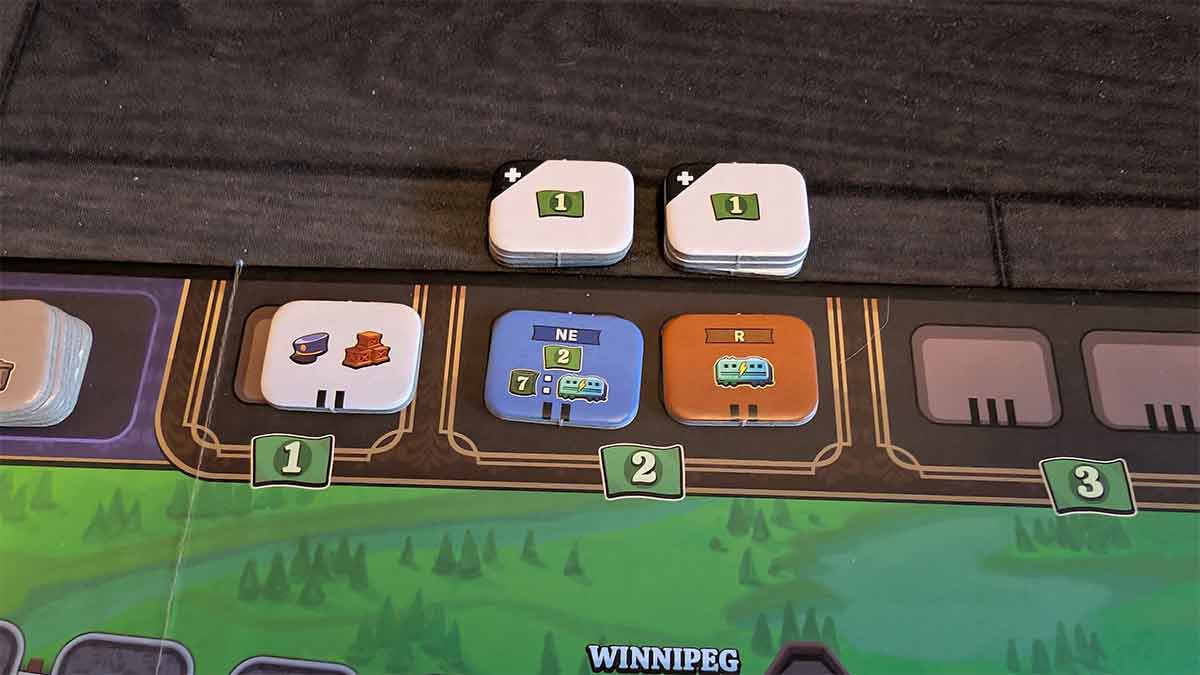
Every time a chip is purchased, the market is refilled immediately. (So you can buy a chip and wait to see what it drawn to replace it before buying more.) The initial cost of the chip is indicated by the markings at the bottom. But, in one of the game’s more unique mechanics, restocking the market only causes existing chips to become cheaper some of the time. When placing a new chip, it is placed in the leftmost spot in the appropriate compartment. Only when a compartment is full–when there are two chips in it–and a third chip for that price is drawn are chips slid to make room. But, you only slide chips that have to be slid, so generally, you’ll only see things get cheaper once every several turns, and as there are always a maximum of six chips out, there will always be empty slots. If the 2 comparment fills, one chip will move into the 1 compartment, there are no chips that start with a cost of one, so this is the only way a chip can cost that little. If that chip gets forced out of the 1 spot, it is trashed (removed from the game.)
Players can always choose to purchase one of the 1 + chips for 2 dollars. These give you a single dollar, but are + chips that don’t fill slots.
Players can also take a loan from the bank whenever they choose. To do this, they take one of the bank loan chips. It gives them $1 for this turn. It does nothing else, so it is basically bloat in your bag. When it’s drawn, it can be trashed for $4. If it’s still in your bag at the end of the game, it’s worth -2 points. (I will note that there are other things that allow you to trash chips, so if played carefully a loan isn’t always terrible.) It’s also worth noting that if you have an effect that is triggered by earning $7 (such as the one provided by Going Public), this is only triggered “naturally” by the sum of your chips, and cannot be made up with earnings from a loan or from cards. Finally, you can only take one loan per turn.
There are several permenant spots on the board at $7 and $8. Also, once someone reaches 25 points, the marker on that board at that spot is added and provides the ability to purchase a lightning train for $4. Which brings up an interesting note: in most bag and deck building games, you do your turn, then purchase. In this game, though, this action, like all of the others, can be taken at any time. That meanst that if you have $7 or $8 early in the game, or $4 later, you can spend your money early in your turn to get an extra lightning train, which can be immediately used that turn.
All chips you buy are placed in your warehouse and can only be used once you eventually draw them from your bag. However, if you buy a chip that has a conductor hat on it, you will also immediately place a locomotive from your supply and add it to your warehouse as well.
Scoring Track Bonuses
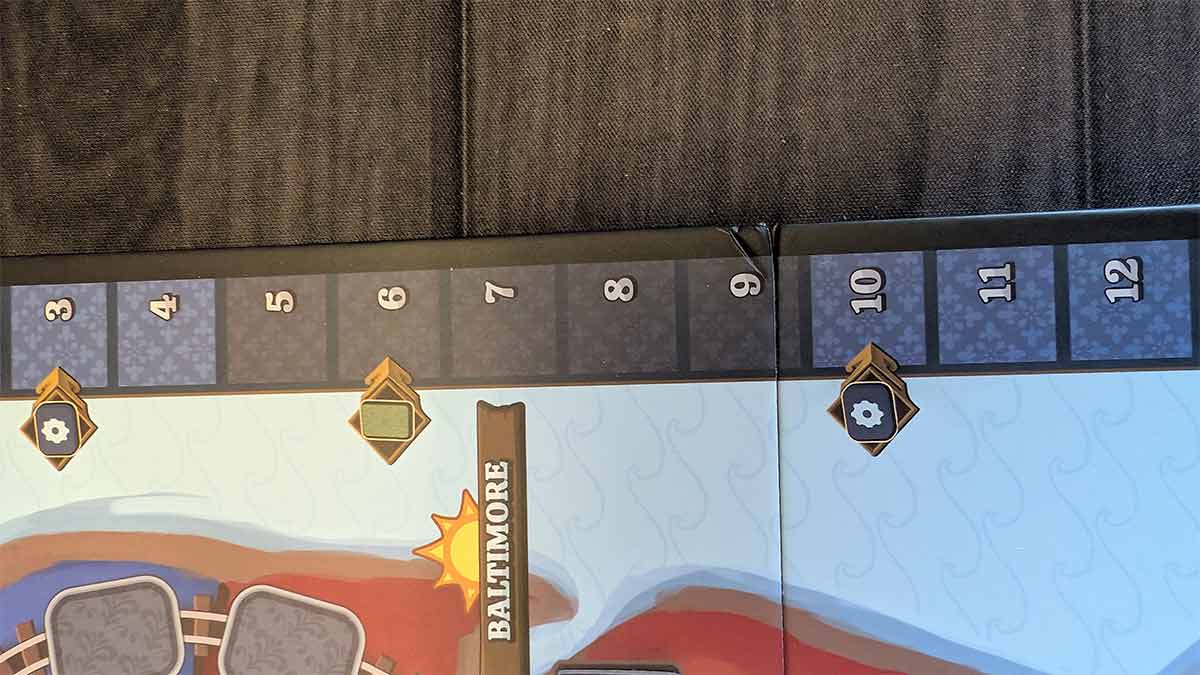
As you earn points, you will unlock bonuses based on the spaces you pass on the scoring track. When you first earn 3, 10, and 15 points, you can any one of the bonus chips on your board and place it in your warehouse. Note that you have four chips but only earn this three times, so you have to pick which bonus you don’t want.
At 8 points, draw a (green) Action card.
At 19 points, if you have a card in your hand, you can draw either a red or a green card, and then discard a card (including the one you just drew) to the discard pile.
And as was mentioned, the first player to reach the 25 point marker places the lightning train bonus tile on the market, meaning that at any point from then on any player can spend $4 to buy a lightning train.
Should any player manage to lap the board and get more than 100 points (and I should mention that in the times I’ve played, no one has scored more than 40 points) you do not get these bonuses on your second lap.
Turnover Phase
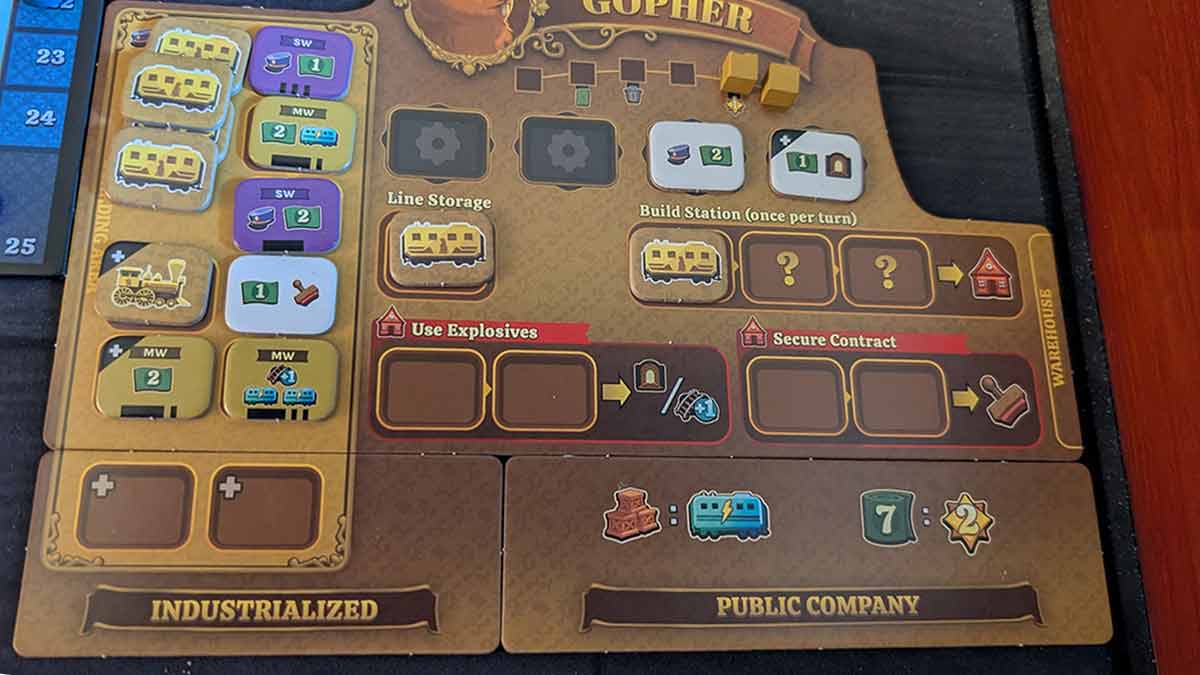
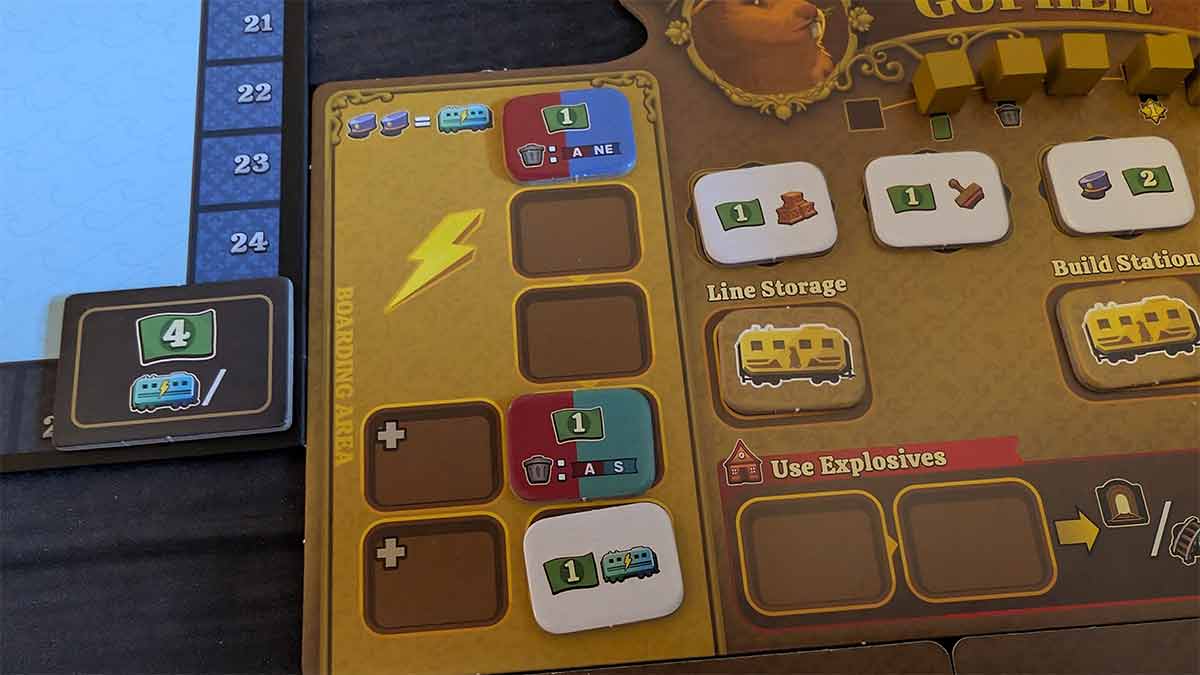
Once you’re done taking actions, there’s one final thing to do on your turn. (And while the rules don’t call this out, I do suggest that the next person start taking their turn while you do this.) First, put any money chips that are still in your boarding area in the warehouse. (All of your trains and locomotives should have been spent on your turn.) Then, draw chips from your bag. Your boarding area has five basic spaces on it, and you must fill those one at a time. However, you also start with two + spaces (and if you industrialize, you’ll get two more.) Any chip with a + on it (all locomotives, as well as a good number of chips you’ll buy from the market) are instead placed in these spots. You keep drawing chips, one at a time, until the five basic slots are full. (It is important to draw chips one-at-time, because the order in which you draw the + chips will matter.) Note that if you fill up all of the available + spots, additional + chips will have to use a basic spot–this is the reason why it’s a good idea to industrialize early.
In the image above, Gold is going to have a good turn next time. They were able to draw six chips thanks to the MW/2 chip going in a plus space. In addition, they got four lightning trains: two for the MW chip (which also gives them a bonus build action), one for the MW chip near the top, and one for drawing two conductor hats. They also score two points, because they have gone public and drew chips that gave them seven or more dollars. They also have a train already banked on Line Storage and another on Build Station from previous turns.
Lightning Trains
I’m honestly not at all clear as to why the game is called what it is, but in-game, lightning trains allow you to add more trains to your bag. Again, the key way you get points is by building lines and then using those lines to make deliveries, but as you build lines, you permenently lose the trains used to build the line. And since you also need trains to do the railyard actions, you need a steady and ideally ever-increasing supply of trains. And that’s where the lightning trains come in.
Anytime you draw a tile with the lightning train icon on it, you will add one train from your supply to your boarding area. These go in the space to the left of the basic slots, and there is no limit to the number of lightning trains you can add on a turn.
You also add a lightning train to your boarding area any time you draw two chips with conductor hats. If you’ve gone public, you also add one any time you draw a chip with the Venture (stacked crates) icon.
These trains can be used for anything that any other train can be used for in this round, and will eventually go back into your bag.
Refilling the Bag
Anytime you need to draw a chip and do not have enough chips left in your bag, you’ll take all of the chips from your warehouse, put them in the bag, and then continue drawing.
The Transcontinental Railroad
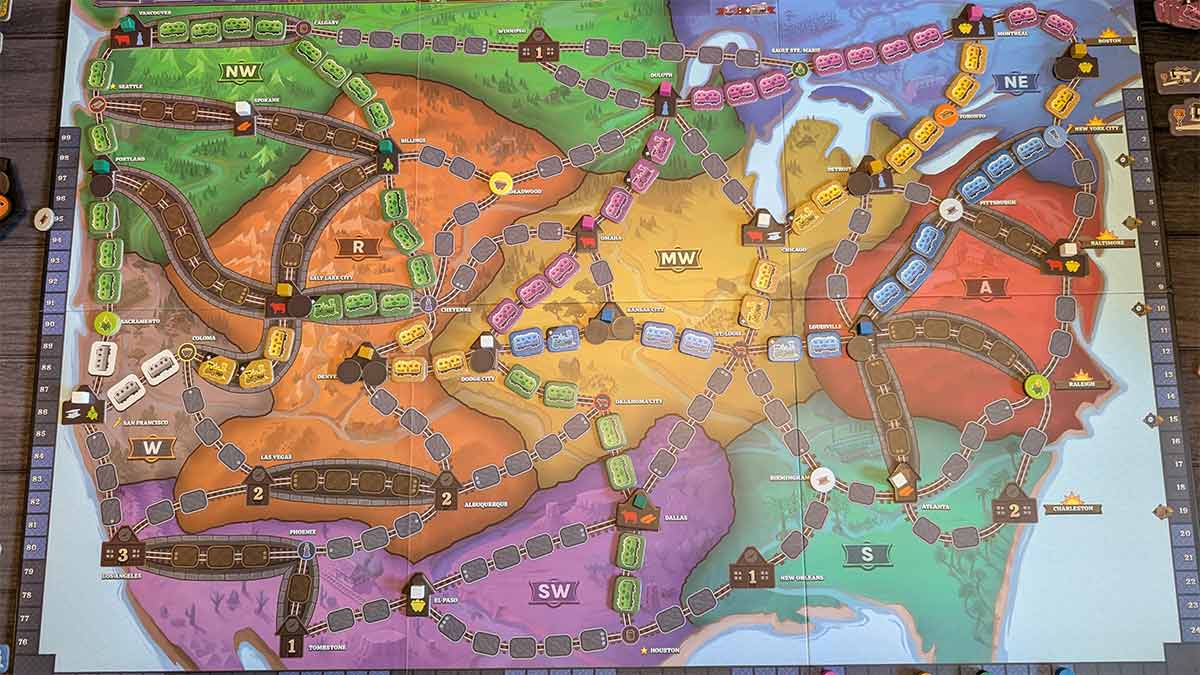
The Transcontinental Railroad is completed once any path linking New York City to San Francisco (sigh, ‡) is completed. As soon as that happens, the game is paused monentarily and the railroad is scored. Count, using the fewest number of lines (it’s possible that the final link might make 2 or more paths complete) the number of locomotives on the line. Each locomotive scores the player two points.
In the image above, all four players have contributed to possible routes. However, only the shortest will score: in this case, NYC->Pittsburgh->Louisville->St. Louis->Kansas City->Dodge City->Denver->Cheyenne->Salt Lake City->Coloma->San Francisco. Blue has two engines on that route and scores four points. Gold has two engines (likely, the final line played to complete the route) and scores four. Green has one and scores two, while purple was shut out.
Note that there are basically three key uses for locomotives. First, they are + chips, so they are trains that do not take up a basic spot in the boarding area. Second, they are the only ways to score points on the Transcontinental Railroad. And third, they are the potential tie-breaker for determining delivery routes.
Game End
The game ends when one of two things occurs.
First, the completion of the Transcontinental Railroad and it being linked to either Seattle or Houston (in a four player game, both cities must be linked to the Transcontinental Railroad.) Once this occurs, players finish the current round and the game is over.
In the image above, that condition has been met: the Transcontinental is complete, and both Seattle and Houston are linked to it.
Alternately, the game is played for 12 rounds. The production cards track this, since there are 12 of them. When the 12th is revealed, the game ends at the end of the round, regardless of the state of the Transcontinental Railroad.
After this final round, every player can attempt to make one final delivery, in turn order. Remember that each station can only take a particular good once, so one player delivering to a station means no one else can deliver that good to that station. Remember as well that deliveries must always use the shortest path, so a last-turn strategy might be to try to make a connection that take away a long potential delivery from another player.
If anyone has mogul cards with end-game bonuses, those are now tallied. The player with the most points wins. Any player who still has a loan loses 2 points per loan.
If there’s a tie, players share the victory.

Lightning Train is GeekDad Approved!
Why You Should Play Lightning Train
I’ve described this game to multiple people as “Ticket to Ride, but with bag building.” Since I am a big fan of TTR, and since I do like bag building games, I was definitely pre-inclined to like this one, and I haven’t been at all disappointed.
While the name is still confusing (I’ll be honest that when I first saw the game, the name combined with the graphic on the box definitely led me to believe that there would be some kind of magical or fantastical element, and, spoiler, there isn’t) tht game offers a great array of tactical and strategic decisions sure to keep fans of heavier games entertained. At the same time, it’s not so complex as to turn off folks (my wife included) who really don’t want to deal with a million things at once.
The train building element is fairly straightforward and will remind folks of the huge number of other train building games. But, I did like the addition of the mountain passes, and the mechanic to build them–dedicating trains to the Use Explosives action–is much easier to remember and track than a lot of similar games that require some formula of extra moves or actions to perform. The limitations on building, though, are where things get interesting. Yes, you can only build one line per turn (most of the time,) and you have to build from either your own station or on to your own line, but both of those are pretty standard elements in games like this. What creates the interesting limitation is the requirement to have a contract for the region you’re building in. That turns out to be the hard part. It’s not a simple matter, as it normally is, to say, “I’m just going to start in some city and build out from there,” because if you don’t have the right contracts, that’s impossible. Instead, what you will find yourself doing more often than not is deciding to build a station somewhere you hadn’t really planned to just because you happen to have that region’s contact tile that round, and so by building the station you can also build the rail line.
The bag building aspect of the game is likewise altered by the lightning trains. Initially, it seems like a hard choice: do I build a rail line and thus permentantly remove those trains from my bag, or do I hold off so that I can have enough trains to do the actions I want? But, you’ll quickly discover that you’re adding one or two trains to your boarding area almost every turrn–there are a lot of tiles that give you lightninig trains–and so you’re unlikely to really run out. But, by having those trains be both the workers that you use for the railyard actions and the trains you’re using to build the lines, it’s very difficult to get yourself in a situation where you don’t have enough trains to keep working towards your goal, while also not having too many trains where you’re unlikely to draw nothing but them, and thus not have other tiles for either other actions or for money.
Providing the ability to leave trains in the railyard between turns also removes a common frustration of bag- or deck-building games, where you might go several turns without drawing what you need and start to feel like you’re falling behind. While, yes, carefuly management of what you have in the bag is an element of the strategy of the game, it rarely becomes a problem here.
I’ve had the opportunity to play the game several times with several different groups, and can attest that it remains a really fun game. It’s long enough to be an interesting game without being so long that it prevents you from playing anything else, and it really hits the sweet spot of being complex enough for serious gamers without becoming so complex that it turns more casual participants away. I think it’s going to find its way to my table a lot this year, which is the main reason I’m giving it the GeekDad Approved designation.
Click here to see all our tabletop game reviews.
 To subscribe to GeekDad’s tabletop gaming coverage, please copy this link and add it to your RSS reader.
Disclosure: GeekDad received a copy of this game for review purposes.

Get ready for a high-speed space battle: with only seconds to place each of your ships, take aim quickly and try not to hit your own ships!
In “Reaping the Rewards,” I take a look at the finished product from a crowdfunding campaign. Light Speed: Arena was originally funded through Kickstarter in the spring of 2024, and was delivered to backers in the summer of 2025. This post is based on my original Kickstarter Tabletop Alert, updated to show the finished product.
What Is Light Speed: Arena?
Light Speed: Arena is a fast-paced battle game for 1 to 4 players (up to 6 with optional expansions), ages 8 and up, and takes about 5 to 10 minutes to play. It retails for about $25 and is available through online retailers and some game stores, though stock may be low. (There should be a new shipment arriving in the US in early March.)
Light Speed: Arena was designed by Tom Jolly and James Ernest and published by Tablescope, with illustrations by Marco Salogni. It is based on Jolly and Ernest’s 2003 game Light Speed, but with some tweaks to the rules and a new app-driven scoring system.

Light Speed: Arena Components
Here’s what comes in the box:
- 4 Mothership tiles
- 32 Spaceship tiles (8 per faction)
- 6 Asteroid tiles
- 4 Corner tiles

So far there are two mini-expansions. Each includes:
- 1 Mothership tile
- 8 Spaceship tiles
- 2 Asteroid tiles
You’ll also need a mobile device running the Light Speed: Arena app, unless you also spring for the Analog Downgrade kit, which includes rubber bands, rulers, and scoring tokens so you can calculate the scores manually.

The asteroid tiles are double-sided and about as big around as a can of soda. Each one depicts an asteroid on one side, and then a “sponsored” side on the other with the name of one of the in-game sponsors like Drift Cola or Destiny Ammo.

The ships come in 4 factions, which are distinguished both by color and style: the red ships look like they’re inspired by farm equipment, with a space barn for a mothership. The green ships have curved wings, while the blue ships are all very boxy. Each ship has a different combination of green, yellow, and red lasers, shields, and batteries, and the four factions all differ from each other as well. The art style is a little cartoony but slick, and it works well with the theme.
The tiles are small squares (slightly larger for the motherships) and are a nice size for handling, which is good because you’ll be shuffling them and then placing them on the table quickly.


How to Play Light Speed: Arena
The Kickstarter page has links to download a draft of the rulebook and a demo print-and-play (which includes access to the beta version of the app) if you’d like to give it a try yourself. The solo mode was not included in the prototype, so my review will only cover the multiplayer version.
The Goal
The goal of the game is score the most points by mining the asteroids, destroying other player’s ships, and protecting your own mothership. If there are sponsored asteroids in play, there are also ways to earn bonus points.

Setup
You’ll need an area roughly 30″ by 30″ to play. Mark the corners of the play area using the corner tiles.
Give each player a mothership and a set of ships of one faction. Place two asteroids near the middle of the arena, and each player places their mothership near themselves, about 4″ in from the edge of the playing area. Everyone shuffles their own stack of ship tiles.
Gameplay
Set up the mobile device nearby and start the game on the app—it will give you a countdown for each turn (the default is 10 seconds per turn, but you can adjust it in a range from 3 seconds up to a full minute).

Each turn, everyone simultaneously places the first ship tile from their stack into the playing area. You may play your ship anywhere as long as it’s not overlapping another tile, and when the timer buzzes you must leave it where it is and draw your next ship tile.
After the last countdown, the game ends and it’s time to score!

Game End
Take a picture of the entire playing area using the app, which will scan the picture and identify all the tiles. After making sure it counted all the tiles correctly, you can proceed to scoring. The app does the scoring for you, playing animations and showing where you gained or lost points (or you can also skip to the final scoring), but I’ll explain how scoring happens.

The ships fire in number order from 1 to 8, and all ships of the same number are considered to be firing simultaneously (though the app will play each one individually). Green lasers do 1 damage, yellow lasers do 2 damage, and red lasers do 3 damage. Shields subtract one point of damage from the laser. You must actually hit the ship illustration itself, not just the ship tile. Each ship (and mothership) has a number of batteries, indicating how much damage it can take before it is destroyed.
- Each time one of your ships damages another ship, you score 1 point.
- If a ship is destroyed, the player who did the most damage to it gets points equal to its full strength. (For a tie, nobody gets the bonus points. Your own ships give you negative points.)
- For each damage you do to an asteroid, your ship gains 1 mining point—but you only score for those if the ship survives until the end of combat!
- If your mothership survives, you score 4 points.
The player with the most points wins!

Sponsored Asteroids
Once you’re familiar with the game, you can flip the asteroid tiles over to play with the sponsor bonus points. Each asteroid adds its own twist:
- Nova Snipe: Any hit (to any ship or asteroid) delivered from at least 28cm (4 asteroid tiles away) gives you 2 bonus points.
- Photonbright: The 5 surviving ships closest to this asteroid at the end of the game will score 3 bonus points each.
- Drift Cola: You get 2 bonus points for close shaves: delivering a hit with a laser that passes through one of your own tiles without hitting yourself.
- Destiny Ammo: Whenever this asteroid is hit, it shoots a laser of the same strength in a random direction.

Faction Powers
Each of the factions has its own power, which you can optionally turn on in the app.
- Amboom (green): When you shoot a ship that was damaged on a previous turn, you instantly destroy it and collect the bonus points.
- Solspear (yellow): Your red lasers pierce the first target they hit and continue through.
- Agronauts (red): The first hit each of your ships takes is ignored, along with all other damage done during that same turn.
- Retroblast (blue): If your ship is damaged, all of its lasers do double damage.
- Black Hole (black, from the expansion): After firing, any nearby enemy ships that were not hit by this ship take 1 damage.
- Glyphon (pink, from the expansion): Lasers that pass through a tile without hitting the ship will still do damage, though Glyphon does not get the credit for the damage.
Light Speed: Arena is GeekDad Approved!
Why You Should Play Light Speed: Arena
Shortly after I was introduced to games like Settlers of Catan and Ticket to Ride and Carcassonne, I discovered the rabbit hole of BoardGameGeek, and one of the things I loved to do was look for games that had unusual mechanics and gameplay. At the time, a lot was new to me, but even then there were some games that really stood out, that felt like nothing I’d ever played before. One of the titles I discovered way back then was this little game called Light Speed. It was from Cheapass Games’ Hip Pocket line—tiny games that literally fit in your pocket, and sold in a little baggie without tokens and counters, which you provided yourself. It probably cost me about $5—less than what I eventually spent on glass beads and tokens to go along with the various other Cheapass titles that I added to my collection.

Some of the things that set Light Speed apart for me were the simultaneous play—you didn’t take turns, but everyone just played at the same time—and the way the entire table was the playing area. There was no board, no grid: you played your cards at whatever angle you wanted, and that determined the direction of your lasers. It was fast-paced, with games often lasting less than a minute once we were experienced, and I loved navigating that fine line between speed and accuracy. Play too quickly, and maybe you end up shooting your own ships; play too slowly, and you don’t get all of your ships on the table. (In the old rules, you just played at your own pace and the game ended when somebody placed their last ship.)

Of course, the play time lasted about a minute or two, but then the scoring took a lot longer. We used a cut rubber band to check the aim (as suggested by the instructions) until I eventually got a cheap laser level that I’d use to project the laser lines, which was a lot of fun. The small cards would get crowded with the glass beads I used for damage tokens, sometimes making it hard to see the lasers. And, of course, if somebody bumped a card while moving tokens around, that could make the difference between a hit and a miss. Even so, Light Speed was one of my favorites, and I was always up for a round or two.
Cut to 2024, nearly 20 years since I first picked up my copy of Light Speed: I happened to see an ad on social media for an app-assisted game called Light Speed: Arena, and it looked oddly familiar. I looked it up and saw that it was, indeed, a new version of Jolly and Ernest’s game, but with a technological twist: now, instead of manually tracing each laser and checking for hits, you could just take a photo of the play area with your phone and let it do all the scoring for you. Could it be? I sent a message to the folks at Tablescope and they were happy to send me a prototype set to try for myself.

The rules have been tweaked a bit from the original but Light Speed: Arena still preserves the feel of the original. It’s lightning-quick (though you can adjust that in the settings!) and still a tightrope walk of speed and accuracy. But being able to just snap a photo of the playing area and have it do the scoring? It’s like magic. While you can just skip to the scores, the app does a great job of making the scoring entertaining, too. You can turn on the commentators, who will pop up to make snarky comments when you shoot your own ships or praise a particularly good shot. The app pans from ship to ship and automatically zooms in and out to show you the lines of fire and how many points each player is earning. (You can have it autoplay, or you can set it up so that you tap to “collect” your points.)
It really is the best of both worlds: the actual play is still analog and old-school, and the app just handles the tedious part that was necessary but not as much fun. (Though if you prefer the old rubber-band scoring method or you don’t want to use a device, the Analog Downgrade kit has you covered, too!) While the app does add some bells and whistles that aren’t strictly necessary (like the sound effects and animations), its primary benefit is actually doing the work that you want it to do without replacing the tactile gameplay. The tiles are much easier to handle (and less prone to warping) than the old Hip Pocket cards, and the illustrations are an upgrade from the original as well.

It’s also extremely customizable: you can play with or without the sponsored asteroids that introduce new rules. You can adjust the timer for playing the spaceships, or you can even just play without the timer at all and just upload a photo at the end, if you wanted to make your own turn-based variant. The faction powers are all individually toggled, so you could let less experienced players use their powers and the more experienced players just use the basic ships. You could even change the number of ships each player has in their supply.
I like all the variety that the asteroids provide. I particularly like the Nova Snipe, trying to set up long-distance shots (and sometimes missing spectacularly). My son was able to make use of the Drift Cola to score a lot of bonus points, in one case passing through two of his own tiles before hitting mine! And for those who just like a bit of random destruction, Destiny Ammo just adds some extra firepower to the field.
The faction powers are fun to play with, though it’s the one thing that I’m not entirely sure is balanced. I looked over the four factions included in the prototype and they have a different makeup of lasers, ranging from 29 to 35 total damage points across the fleets. I assume that the difference is made up by the faction abilities, but does that mean some fleets have advantages when you’re not using the special powers? The abilities also have different difficulty levels: knowing that your red lasers can pierce, or that you get instant destruction on anything that has been damaged already is a little easier to take advantage of. Dealing double damage if your ship has already been shot is a bit trickier, because you may want to shoot your own ships to trigger that … but it makes it more likely your ship will just get blown up before it even fires! The red faction’s ability to ignore damage seems extremely powerful, though it’s entirely defensive and generally doesn’t help the red player score more points. That said, I haven’t noticed any single faction winning more often than others—and the game is so fast-paced that you won’t even really care. If you’re really concerned about balance, just play several games and rotate factions each round!
As you may know, I normally do not award the GeekDad Approved seal to unpublished games, because I want to see the finished gameplay before I make my final determination. In this case, I felt that Light Speed: Arena had already surpassed my expectations even in its prototype form. Since receiving the finished copy and using the finished app, I’m even more certain that this deserves our seal of approval. Between the prototype and the finished copy, I’ve played Light Speed: Arena 50 times, and never tire of introducing it to people.

I’m also really impressed with the finished app: with the beta version, I’d occasionally have to retake the photo because it was missing a spaceship or two in the count, and I’d have to try a different angle to avoid shadows or glare. With the finished app, I don’t think I’ve ever had to retake a photo, even when we were playing in a dim hotel lobby or in a room that had a lot of glare from overhead lights.
If you enjoy real-time games (and space lasers!), don’t miss this fantastic revival of an old favorite.
Click here to see all our tabletop game reviews.
To subscribe to GeekDad’s tabletop gaming coverage, please copy this link and add it to your RSS reader.
Disclosure: GeekDad received a copy of this game for review purposes.

Justice League Red #6 – Saladin Ahmed, Writer; Clayton Henry, Artist; Arif Prianto, Colorist
Ray – 8.5/10
Ray: It’s the final issue of this action-packed techno-thriller, as the true villain has finally been revealed – the Crimson Cloud, a sinister AI linked to Red Tornado who has now taken over in fully. The visuals by Clayton Henry here are top-notch, and the Cloud manages to take advantage of the team by showing us snippets from each of their worst fears and lowest moments – Red Canary in particular gets a really affecting one for any child of immigrants. In many ways, she turns out to be the main character here, thanks to her unique connection to the Red and her key role to play in the final battle. The hints at a major death here were clearly never going to happen, and that’s for the best, but this issue does a good job of restoring Red Tornado’s character and doing some interesting things with this misfit group of heroes, although I don’t know if this team dynamic will be revisited any time soon.

Harley & Ivy: Life and Crimes #3 – Erica Henderson, Writer/Artist
Ray – 9/10
Ray: Erica Henderson’s cartooning is some of the best in the business – the perfect mix of exaggerated and perfectly evocative. Harley and Ivy have formed a tight bond, but now it’s tested like never before with the return of the Joker at his most unappealing. This is skinned-Joker, with his repulsive stapled-on face, and yet he’s still able to put on the sad-sack act, trying to win Harley back after all his abuse. Harley’s vulnerability and Ivy’s anger makes it seem like something genuinely bad is coming – but there’s a great swerve followed by one of the most satisfying moments of the series and a great series of jokes about it. While this is a very quick read, mostly told in double-page spreads, it’s the perfect length and pace it needs to be for a critical moment in Harley and Ivy’s relationship. The sex jokes don’t distract all for just how good these two are together.

Harley Quinn #58 – Elliott Kalan, Writer; Carlos Olivares, Artist; Marissa Louise, Colorist
Ray – 8/10
Ray: In the aftermath of the Deconspirator’s attack on Throatcutter Hill and the death of a supporting character, Harley is trying to pick up the pieces, help the people affected by the attack – and sort out her confusing feelings for Althea Klang. Just like Janet over in Ivy’s book, I do find this subplot the least interesting part of the title, but it is amusing that Harley’s idea of courtship continues to be trying to blow up Klang’s building. But she doesn’t get the chance – because a new villain named Colonel Blimp descends into the city and starts dropping bombs. This leads to a chaotic string of pages as Harley tries to save the very building she just tried to blow up, and in the end of the issue she’s finally ready to take her evil billionaire love interest out on a date. Fun issue, but it kind of feels like we’re circling around the same few plot points with stopovers for colorful new villains.
To find reviews of all the DC issues, visit DC This Week.
GeekDad received this comic for review purposes
]]>
Batman: Detective Comics #1105 – Tom Taylor, Writer; Mikel Janin, Artist; Wayne Faucher, Norm Rapmund, Inkers
Ray – 9.5/10
Ray: The mysterious villain known only as the Lion has been haunting this arc since the beginning, infecting Gotham and Batman with a plague that removes the capability for fear. As Batman’s own personal clock before he loses his mind ticks down, he continues to search for answers – and he’s finally found them in the form of the identity of his new villain. It’s a boy whose father he arrested years ago, and the boy wound up a traumatized agoraphobe. But sealing himself away in his foster mother’s home, he became a scientific genius and obsessed with eliminating fear’s power over him. His quest to make himself stronger took him all over the DCU – all funded by one man. This is actually a really cool dynamic, because Leo deeply admires Bruce Wayne, but absolutely hates Batman. And now, he’s ready to take the “Gift” he gave himself and spread it to everyone.

With time running out, Batman has assembled a team of the best scientists in the world to try to find a cure for him – and for the little boy they found in the hold. This is a great opportunity to bring in some of the top science heroes from around the DCU, although Lana Lang being included always seems like such a random addition – her being a scientist was barely even a plot point until a few years back! But Gotham is quickly plunging into chaos, and it becomes clear that the Lion’s agenda is much further along than anyone knew. The use of Scarecrow in this arc has been pretty clever – of course this is a plot he wants to stop – and the Lion makes for a great villain because his MO is genuinely something we haven’t seen much of in comics. The tension has been building with every issue, and now that the Lion is ready to bring his war to Gotham, we’re headed for a tense conclusion.
To find reviews of all the DC issues, visit DC This Week.
GeekDad received this comic for review purposes
]]>Last Spring, I wrote about the state of the game of Marvel: Crisis Protocol. The tl;dr? The game’s in great shape.
For quite awhile, the easiest way to get into Marvel: Crisis Protocol was to pick up either the original core set, or the newer Earth’s Mightiest Core Set. Both of these sets were designed to give two players enough miniatures, terrain, and accessories to learn how to play the game. But neither core set is suited to an important aspect of playing Marvel: Crisis Protocol: building a roster.
Roster building is essentially the army building of the game. In a nutshell, each player selects 10 of their characters for their roster, along with 10 Team Tactics Cards, 5 Secure Crisis Cards, and 5 Extraction Crisis Cards. You bring this roster to a game, where you and your opponent will draw Crisis Cards to form the Mission you will play. Each Mission will have a certain Threat (aka point) value. You then will form a squad equal to or under the Threat value of the mission.
Atomic Mass Games has recently introduced single-player Starter Sets for Marvel: Crisis Protocol, handily giving a player a ready-made roster of 10 characters. At this point there are two sets available: the Spider-Foes Starter Set, and the X-Men Starter Set. These sets take characters previously available in other, smaller, sets, and combine them with all the gameplay accessories you’ll need to play the game.

Even though the Spider-Foes box is much larger than the X-Men one, both starter sets have similar content. The size discrepancy has to do with several larger figures in the Spider-Foes set.
Marvel: Crisis Protocol Starter Sets
The Marvel: Crisis Protocol Spider-Foes starter set comes with the following characters: Green Goblin, Kraven the Hunter, the Lizard, Mysterio, Shocker, Sandman, Carnage, Rhino, Vulture, and Electro. It retails for $94.99, and is available from Amazon or directly from Asmodee, the parent company of Atomic Mass Games.
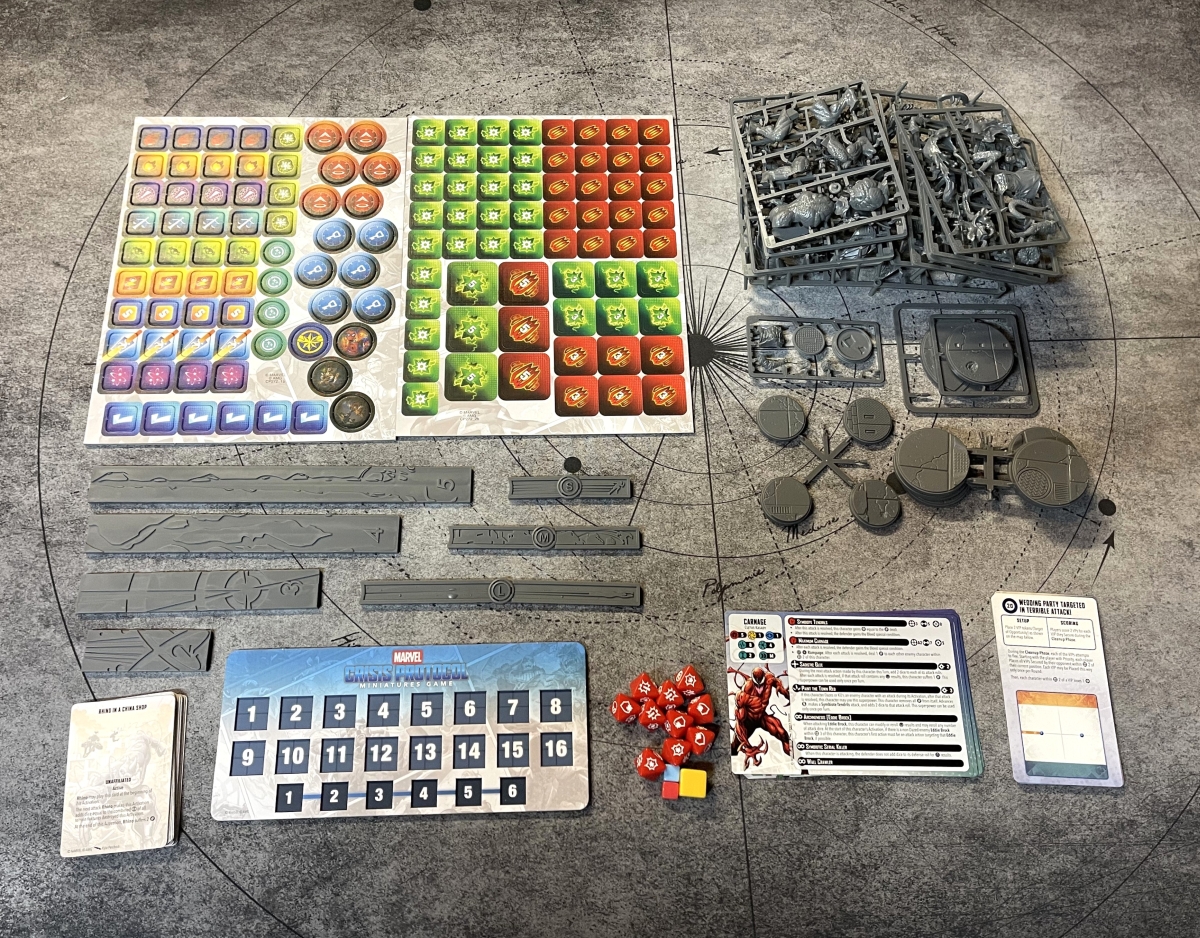
The Marvel: Crisis Protocol Spider-Foes starter set contains the following:
- 12 minis
- 10 Stat Cards
- 1 Sand Construct card
- 21 Team Tactics cards
- 12 Crisis Card
- 10 Dice
- 1 Punch sheet
- 3 Movement Tools
- 4 Range Tools
- 1 Mission Tracker
- 3 Tracking Cubes
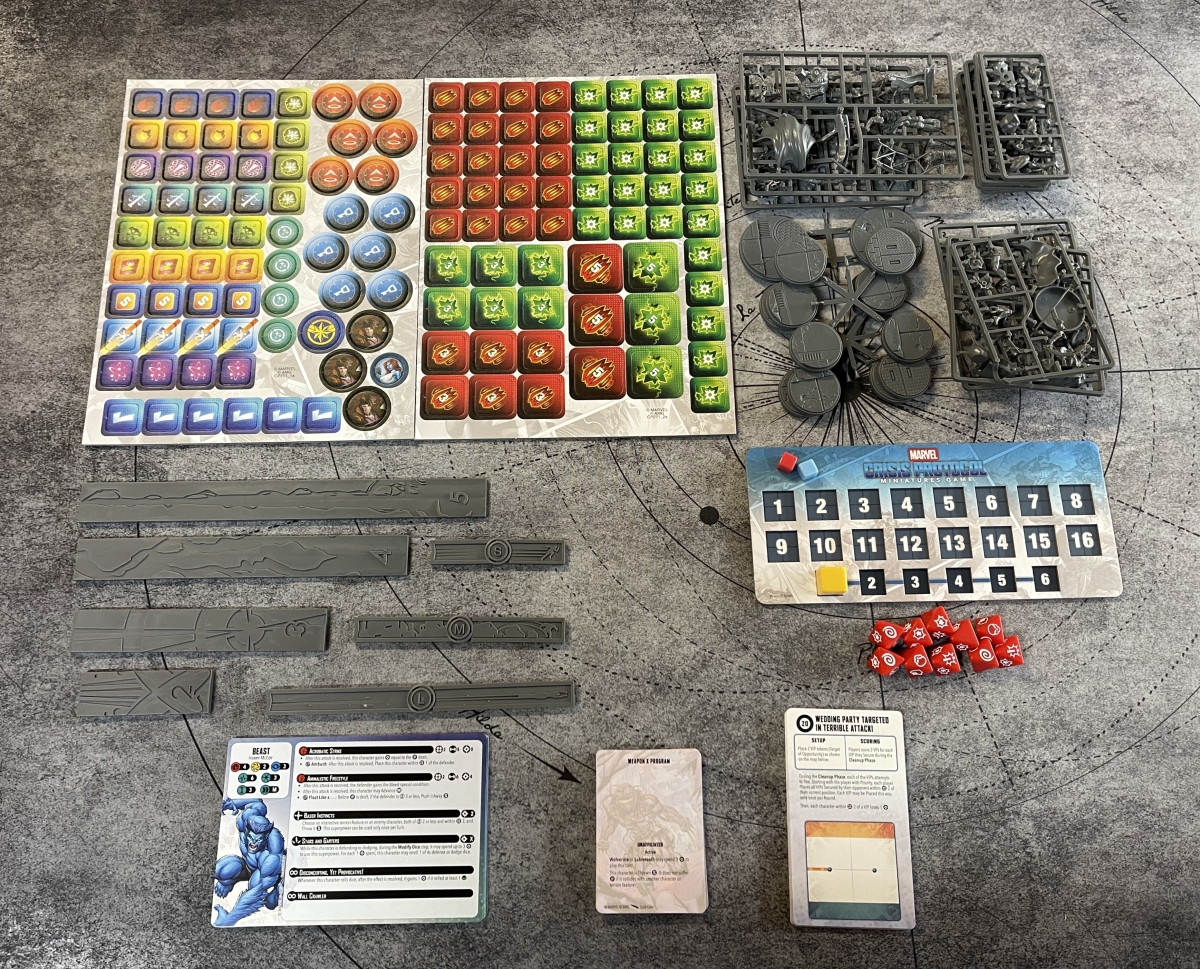
The Marvel: Crisis Protocol X-Men starter set comes with Cyclops, Wolverine, Storm, Beast, Rogue, Gambit, Magneto, Toad, Mystique, and Sabretooth. It also retails for $94.99, and is available from Amazon or directly from Asmodee.
The Marvel: Crisis Protocol X-Men starter set contains:
- 12 Miniatures
- 10 Character Stat Cards
- 19 Team Tactics Cards
- 12 Crisis Cards
- 2 Punch Sheets
- 10 Dice
- 3 Movement Tools
- 4 Range Tools
- 1 Mission Tracker
- 3 Tracking Cubes
Atomic Mass Games doesn’t include any manuals. Instead, the rules and miniature assembly instructions are available to download from the Atomic Mass Games website. This is to ensure that players always have access to the most up to date rules for Marvel: Crisis Protocol.
Starter Set Common Components
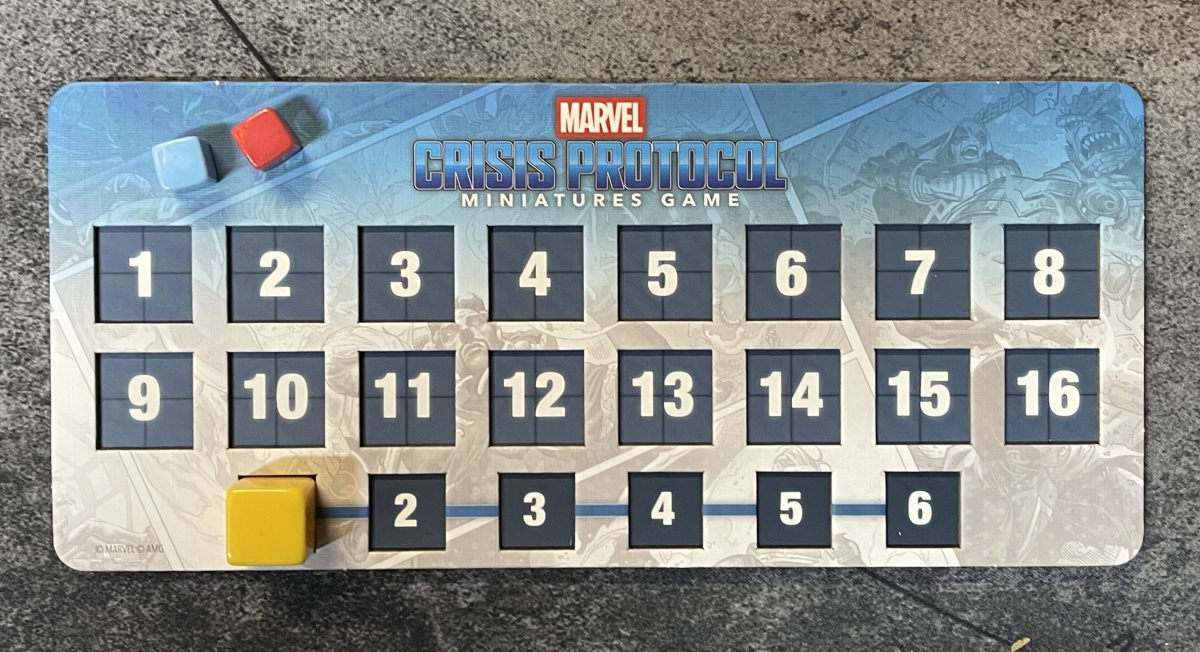
The mission tracker is a 2-layer board that allows both players to keep track of their progress in a match.

A full set of dice are included with each starter set. These MCP-specific eight-sided dice trigger different results as detailed in my original review of Marvel: Crisis Protocol.

Marvel: Crisis Protocol uses special tools for both movement and measuring distances. The starter sets come with both. Players often will also paint these tools to make them more dynamic.

Both sets come with a bunch of tokens. While the tokens sheets pictured above are from the Spider-Foes set, the X-Men set is almost identical, each with just a few different tokens specific to their respective sets.
Spider-Foes Starter Set Components
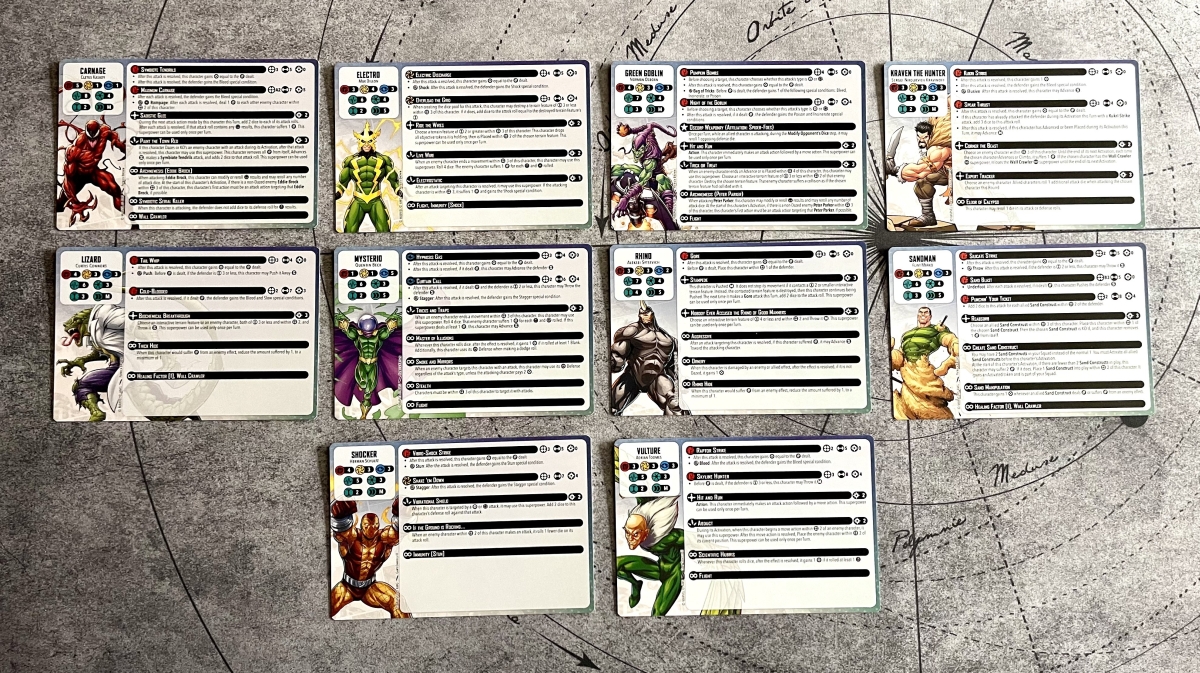
There are 10 double-sided character stat cards included for Spider-Man’s enemies. Additionally, Sandman has two sand constructs which function as minions. Therefore, he also comes with two character stat cards for the two constructs.
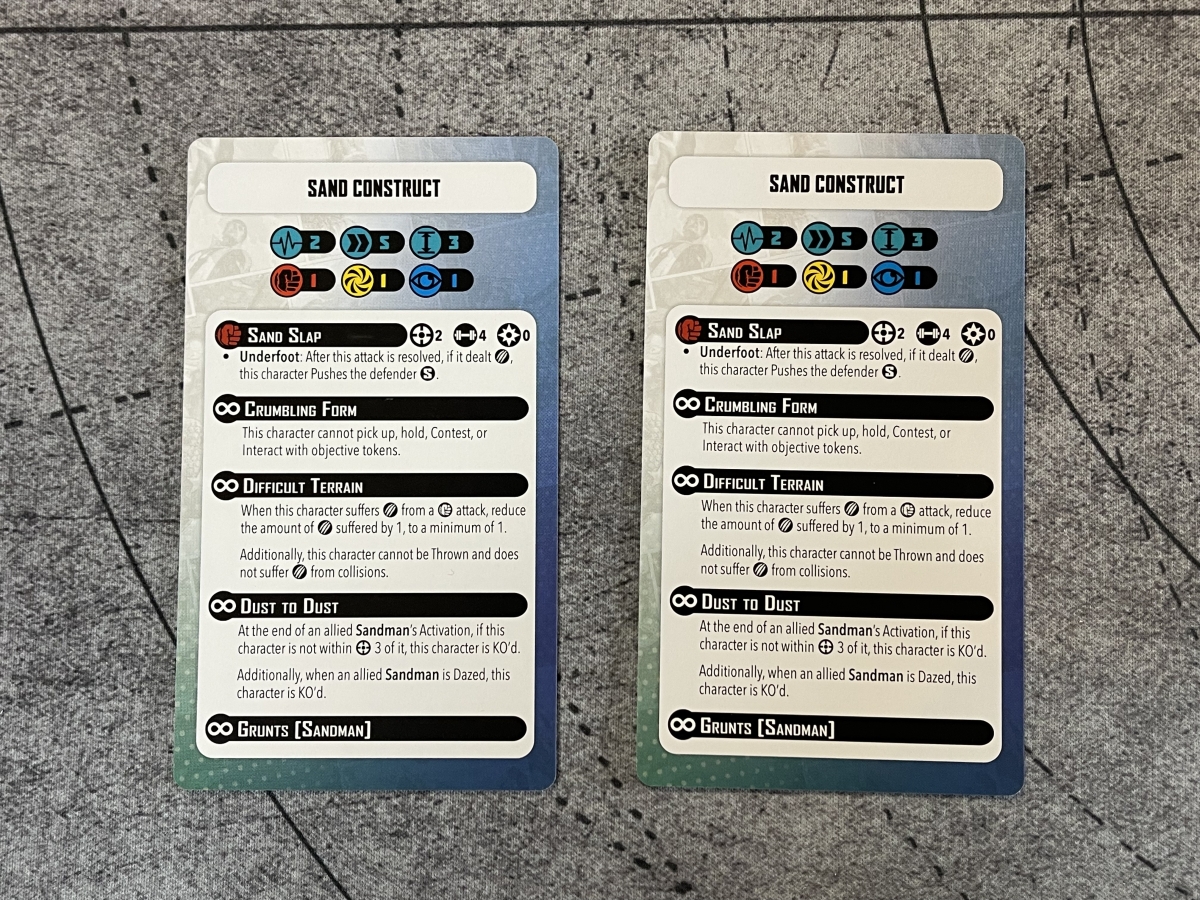
The Spider-Foes starter set comes with 21 different team tactics cards. These cards are special team up powers you can use during the game.

There are also 12 crisis cards, which are used to set the mission for a game of Marvel: Crisis Protocol. The crisis cards come in two different varieties: Secure, which are about holding areas of the map, and Extraction, which are about retrieving and carrying something across the map.

And then, of course, there are the miniatures. I assembled all of the minis from the Spider-Foes starter set:
Click to view slideshow.
As you can see, it’s a good representation of Spider-Man’s enemies. The only major omissions are Doctor Octopus, who can instead be found in the Earth’s Mightiest Core Set, and The Kingpin, who is in the Criminal Syndicate Affiliation Pack.
X-Men Starter Set Components
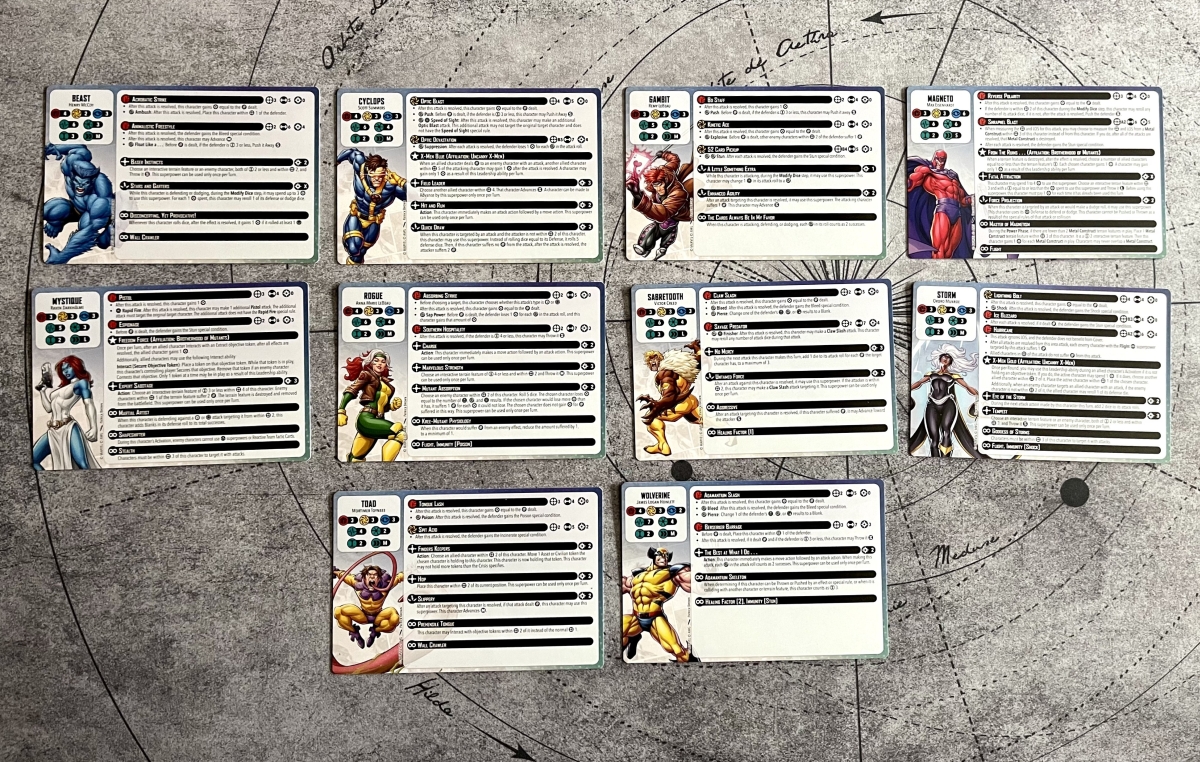
As with Spider-Foes, the X-Men starter set comes with 10 double-sided character stat cards.

There are two less team tactics cards in the X-Men set than with Spider-Foes.
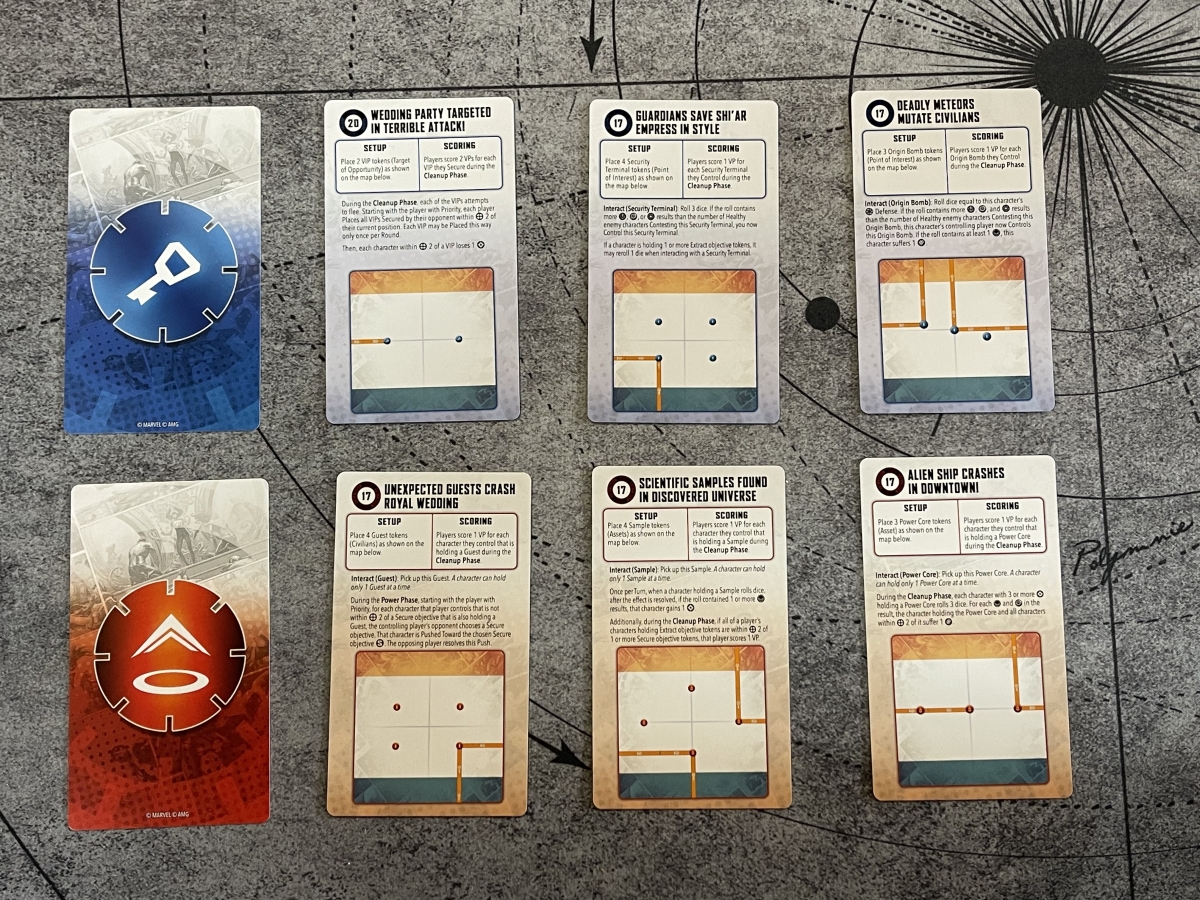
There are also 12 crisis cards included in the X-Men set, though the website lists the number at 6:
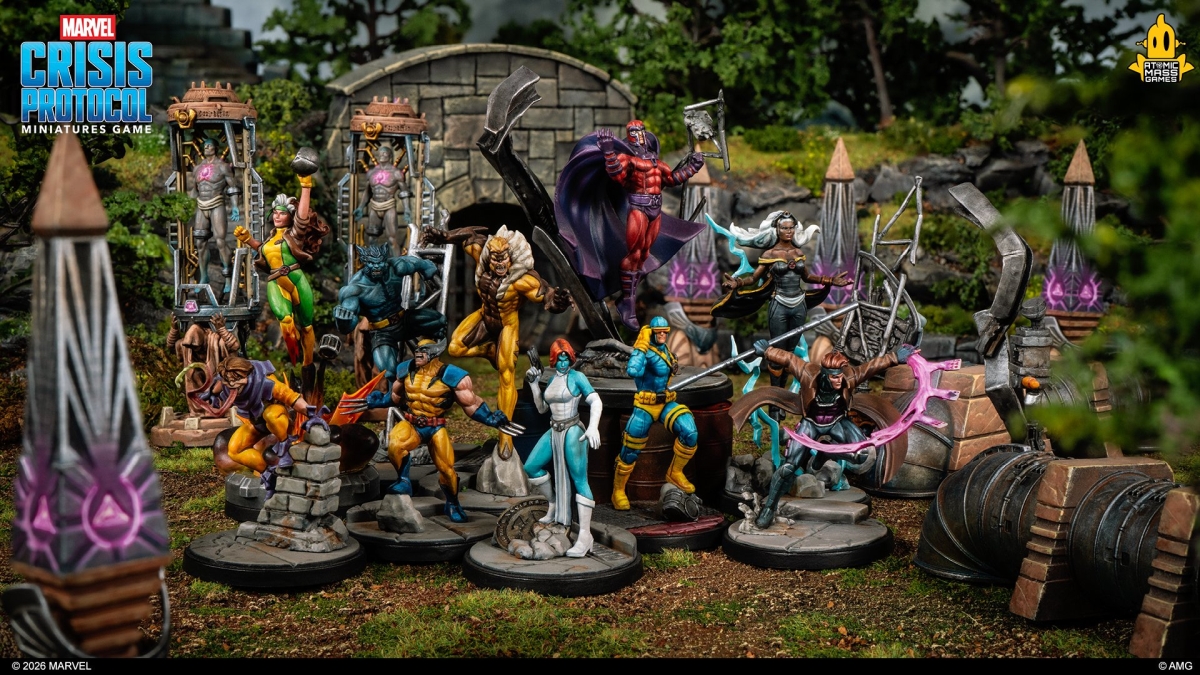
I didn’t have time to build all of the X-Men starter set figures, but here’s what they will look like, assembled and professionally painted:
Who Are These Starter Sets For?
I suppose it goes without saying that these starter sets are great ways for individuals to jump into playing Marvel: Crisis Protocol. As I had stated before, the sets come with a complete 10-character roster, so you can build and paint those minis and bring them to play with an opponent. Really, the only thing that you’re missing out of the sets is some terrain. But other players of Marvel: Crisis Protocol or your local game shops likely already have the terrain you need to play. Or, if you want your own dedicated terrain, Atomic Mass Games also has a whole variety of plastic terrain kits available, from Doctor Strange’s Sanctum to the Avenger’s quinjet.
Whether as a start to playing Marvel: Crisis Protocol or for collecting a particular faction, these starter sets are phenomenal values. Let’s look at the X-Men starter set. All of the miniatures in this set were previously available in three separate boxes: an X-Men Affiliation Pack, a Brotherhood of Mutants Affilation Pack, and a box containing just Gambit and Rogue. The retail price of those three boxes totaled $169.97. And that’s just the miniatures; there’s still the additional cost of the dice and the movement and range tools. So if you want to get started playing with either X-Men or Spider-Foes, you’ll be saving almost $110 from purchasing a starter set.
If you want to get started with Marvel: Crisis Protocol or even if you’re looking to start a new character affiliation, both the Spider-Foes starter set and the X-Men starter set are great ways to go. Both boxes are chock full of content, and easily expandable with other characters that share the affiliations of the ones inside these starter sets. A definite recommend.
For more information on Marvel: Crisis Protocol starter sets, head to the Atomic Mass Games website.
Click here to see all our tabletop game reviews.
To subscribe to GeekDad’s tabletop gaming coverage, please copy this link and add it to your RSS reader.
Disclosure: GeekDad received a copy of this game for review purposes. As an Amazon affiliate, I may earn a small commission on qualified purchases.

Green Lantern #31 – Jeremy Adams, Writer; Montos, Artist; Romulo Fajardo Jr, Colorist
Ray – 9/10
Ray: Hal Jordan’s journey through his old address book has taken him to Green Arrow and Batman as he seeks advice on his bizarre encounter with the Book of Oa. But now his next stop is in Central City, as he needs help from Barry Allen – but it might be Barry who’s in more immediate need. Barry, who lost his powers at the end of Absolute Power, has successfully found evidence of criminal activity from a new mob boss, enough to put the guy away for life. That is, if he survives to trial. The boss has put a hit out on Barry, and the police trying to take him into witness protection are in on it. Barry barely escapes with his life just in time for Hal to show up, fending off the crooked cops, and the two are able to catch up – just in time for the boss to call in his next agent, a massive metahuman enforcer by the name of Bruto, who is ready to tear through the city to find Barry.

With the villain hot on their trail, Barry and Hal are able to catch up on the go, but this issue has much less to do with Hal’s personal struggles than it does with no-holds-barred action. Bruto is a hilarious villain, essentially a massive hulk of a man who also talks like an old-timey gangster with a 1920s vibe, and makes for a massive threat. Montos was a great choice for the artist on this issue, bringing a noir vibe to what’s usually a much larger-scale comic. Every one of these one-shots has had a slightly different vibe to it, which helps to make this a great bridge arc before we head back to space. The title’s getting a huge shake-up soon, with Kyle Rayner taking over the lead role. So far, Jeremy Adams has done an amazing job of building up Hal for this big test ahead, and this arc has been more about getting him in the right head-space for his next big cosmic adventure.
To find reviews of all the DC issues, visit DC This Week.
GeekDad received this comic for review purposes
]]>
Absolute Martian Manhunter #8 – Deniz Camp, Writer; Javier Rodriguez, Artist
Ray – 10/10
Ray: The most surreal book in the Absolute line – and one of the most strange and unique titles DC has ever put out – continues its stream towards a twisted finale with this issue, which takes us deeper into the dark underbelly of the country at the moment through the filter of a oddball sci-fi tale. John Jones’ bond to the Martian has unraveled his life, costing him his family and nearly his job. He’s taken to drowning his sorrows in alcohol, as the pressure of a constant psychic connection is near-unbearable. At the same time, the White Martian seems to be striking again, with the FBI suddenly getting a rash of calls of people informing on their neighbors, friends, and even family. This topic was relevant when this was written already, but over the last few weeks, this tale about a rash of paranoia turning everyone into enemies seems even more so – to an uncomfortable degree.

The stress of this situation has gotten to John to such a degree that his relationship with his “other” is breaking down, and he asks the Martian to leave him alone for a day – let him sort things out privately. The Martian agrees, and we follow the two of them through their own days. John tries to reconnect with his wife, but it’s clear there are some deep rifts as long as she’s convinced she’s a danger to him and everyone around him. As for the Martian, he goes through his own adventures, bonding with one person after another – and that raises the attention of a shadowy group that may have been tracking him all along. The visuals in this issue are on a new level, with Rodriguez playing some fascinating games with format. And the ending introduces a major new player, leaving readers with a pit in their stomach. Again, there simply isn’t even the slightest hint of a weak link in this line.
To find reviews of all the DC issues, visit DC This Week.
GeekDad received this comic for review purposes
]]>
Absolute Flash #11 – Jeff Lemire, Writer; Nick Robles, Artist; Adriano Lucas, Colorist
Ray – 10/10
Ray: For the first ten issues of this series, it kept the focus tightly on Wally West and his journey to try to master his new powers. Barry Allen, his mentor in most versions, was long gone – killed in the explosion that gave Wally his powers. But a few issues ago, we got a glimpse into the Speed Force for the first time – and discovered that Wally wasn’t the first one to access it. And now we know the truth – Barry is dead, but he’s not gone. The Speed Force is a completely different thing in this world, a much more menacing one, and now it’s been opened – and Eobard Thawne is free. Transformed by the cosmic energy within, Eleanor Thawne’s long-lost grandfather has escaped and is tearing through the labs – forming uneasy alliances as Rudy West battles to get free and finds the Rogues doing the same. The Rogues have been one of the big highlights of this series.

However, the other half of this story is where Lemire and Robles really shine. Wally finds himself in a strange, red-tinged landscape where Barry and countless other beings exist as Speed Force spirits. They’re all scientists, all made their way into the force – and all died trying to make it in. Now they coexist there, communicating as best they can between a hundred alien languages, and try to make sense of the strange land they find themselves in. I think in retrospect, it was a smart move to immerse us in Wally’s story before things got so big and crazy. We’re invested in this kid now, and this issue is really the payoff to the quest he’s been on since the first issue. This is the kind of story that the Absolute Universe excels in – taking familiar characters and taking away their safety net. You see what they’re really made of when everything is on the table, and no one is safe.
To find reviews of all the DC issues, visit DC This Week.
GeekDad received this comic for review purposes
]]>
Absolute Wonder Woman #16 – Kelly Thompson, Writer; Hayden Sherman, Artist; Jordie Bellaire, Colorist
Ray – 10/10
Ray: Fresh off a battle against the dark energy within her and a team-up with the dark knight, Diana is ready to reap the rewards of her new fame – but something much darker is looming. Wonder Woman’s journey in the labyrinth gained her several new allies, as well as a unique opportunity to connect with her culture, and her efforts in saving Gateway City has made her the most popular and beloved hero in the Absolute Universe. Now, the Gateway City Museum is opening a new exhibit that will celebrate the culture she comes from, and she’s the guest of honor. But her presence is increasingly causing more conflict, as the government continues to view her as a hostile force, and Steve Trevor actually goes so far as to resign his commission in protest. All this is looming over her head as she attends the museum as the guest of honor – and Veronica Cale is almost ready to make her move.

There are some brilliant flashback segments in this issue, dealing with Diana’s visits from the Gods when she was growing up in Hell. There’s a haunting opening segment involving the innocent but slightly eerie affection Aphrodite gave the young princess, only for the Goddess to disappear later in Diana’s life and be replaced by Artemis, who taught her how to fight but didn’t give her the answers she was seeking. And when it’s time for the real battle to begin, things get scary in a hurry. Zatanna, who is a prisoner of Cale and being forced to attack, may be the deadliest enemy she’s faced yet – because she’s ready to turn Diana’s own magic against her. We also get our first look at Cale’s full team, with a familiar name and a completely new roster – and it asks some very big questions about one of the members of Diana’s friends. This continues to be one of the best books on the stands every issue.
To find reviews of all the DC issues, visit DC This Week.
GeekDad received this comic for review purposes
]]>
Absolute Batman #16 – Scott Snyder, Writer; Nick Dragotta, Artist; Frank Martin, Colorist
Ray – 10/10
Ray: Every month I think Absolute Batman can’t get any better, and then it surprises me. Scott Snyder has built a world full of untold horrors here, with villain that make the original versions look like boy scouts, but at its core is a Bruce who might be a kinder and gentler person than ours ever got to be – after all, he’s a momma’s boy. After the horrors of the Bane arc, Bruce is back to work and trying to piece his life back together – but he’s lost most of his friends, with Oz and Harvey hating him and Waylon lost in his own mind. That leads him to contact Diana, who he last teamed up with in the previous issue of Absolute Wonder woman, and he asks for a magical way to cure Waylon. She knows a way – but it involves a deep journey into the underworld to undergo a series of magical trials and eventually get an amulet of transmogrification from a powerful warrior of the dead. No big deal, right?

Nick Dragotta has always been one of this series’ secret weapons, but he really outdoes himself this issue with a magical wilderness that packs a ton of detail into several pages with panel-heavy layouts, before taking us into an epic arena for a dramatic battle. But along the way, there are some great quiet moments, especially one where Bruce – closer to the afterlife than ever before – encounters his father. The legacy of Thomas Wayne in this world is very different, but no less critical to who Bruce is as a person, and that becomes really clear this issue. I also have to add that after two team-up issues between these two heroes, it’s clear that Batman and Wonder Woman have a surprising amount of things in common and are forming a really interesting platonic bond – and thankfully only that. Can’t wait to see how Superman fits into this dynamic once he gets his crossovers.
To find reviews of all the DC issues, visit DC This Week.
GeekDad received this comic for review purposes
]]>
The Flash #29 – Mark Waid, Christopher Cantwell, Writers; Vasco Georgiev, Artist; Matt Herms, Colorist
Ray – 9/10
Ray: Mark Waid last left his mark on the DCU in the 1990s, before his resurgence at the company in recent years, and the biggest impact may have been on the Flash where he wrote what many consider the definitive Wally West run and also introduced us to a host of other fan favorite characters like Impulse. And all that comes full-circle here for a story that weaves through time as the Dark Legion tries to end the Speed Force for good – by disrupting the accident that gave Barry his powers. At this point, Barry is just a meek scientist, and with Bart stuck in the present suffering from Speed Sickness, Wally has to face them down alone. There are some great details here, like Barry initially thinking Wally is Jay Garrick, and Waid’s handle on Bart is still as great as it was when he and the late Mike Weiringo were tackling the character. He’s still as funny as ever, but also far from incompetent.

In fact, Bart winds up being the linchpin to this entire story, as the Legion comes extremely close to wiping out the Flashes for good. There are some really interesting plot points in this issue, like one Legion member with a unique reason for not being all-in on Darkseid’s plan. And things get so tense towards the end of the issue that I was actually starting to wonder – is this Waid sending off Bart with a proper story written by his co-creator? After all, all the Young Justice generation has been sort of ill-used in recent years, and there’s always that fear. But instead, Waid seems to potentially set Bart up for a much bigger role going forward, one that plays heavily into his origins from the future. While this issue resolves a lot, it also sets up a potentially bigger crisis in the next issue as this creative team prepares to mic-drop – and tee things up for Ryan North and Gavin Guidry in March.
To find reviews of all the DC issues, visit DC This Week.
GeekDad received this comic for review purposes
]]>
Justice League Unlimited #15 – Mark Waid, Writer; Dan Mora, Sean Izaakse, Artists; Tamra Bonvillain, Colorist
Ray – 9.5/10
Ray: As DC KO marches on towards its epic conclusion, this tie-in does a great job of covering the chaos on Earth. This issue introduces a new player in the battle for Earth – Air Wave, who has finally made his way back from the mission that got lost in time. As the battle shifts from fighting villains to taking the fight to Neron and keeping him from collecting souls en masse, the heroes deputize a new Costa Rican team of heroes alongside Air Wave and Kid Flash to make their way to Neron’s temple. One of the best things about Mark Waid on a title is that the man has an encyclopedia of DC knowledge that few mortal men can match, and now he has the entire DCU to play with. This issue feels particularly action-packed, but it’s also got enough time for some great character moments – and of course, it has one of the DCU’s best villains to play with, in the sadistic demon Neron.

This twisted deal-maker was created by Waid thirty years ago in the event Underworld Unleashed, and this comic feels like a proper sequel to that. While Neron does get the chance to torment Ace West, his machinations are mostly confined to the underworld, where Mister Terrific and his band of time-displaced heroes continue their march through Hell. The numbers keep on dwindling one by one, with one hero making a final sacrifice to get them through a frozen wasteland and another falling prey to a trap and being turned into a monster. Another finally succumbs to his deepest fears, and the final level of hell contains twisted horrors that tear some to shreds. It ultimately comes down to Michael Holt alone to face off with Neron and try to cut a deal, but the demon king has one last surprise up his sleeve. This is probably the best issue of this storyline so far, with some great horror vibes.
To find reviews of all the DC issues, visit DC This Week.
GeekDad received this comic for review purposes
]]>
Superman #34 – Joshua Williamson, Writer; Eddy Barrows, Penciller; Eber Ferreira, Inker; Alejandro Sanchez, Colorist
Ray – 9.5/10
Ray: Joshua Williamson has done a lot of incredible work over at DC, but his crowning achievement might just be the redemption of Superboy Prime. The character was both universally hated and seen as pure evil, but under Williamson’s pen, he’s getting one hell of a storyarc – so much so that people are even comparing him to fan favorite Steve Harrington of Stranger Things. Of course, the one doing the real heavy lifting here is Lois Lane, who has been left to supervise Prime and a lone Superman robot while Superman is off competing to become a God. With her powers restored and the Legion temporarily repelled, the trio head off to try to save who they can. Prime, naturally, doesn’t get why they should be working on minor issues like this, but the Superman Robot is programmed to be, think, and feel like Superman does – and he has some pretty profound things to say.

Prime’s always been an interesting hook for a character – a version of Superman from a world where Superman is a fictional character, and was corrupted when he lost his world. For the longest time, it seemed like he was too far gone and had no desire to change, but Lois’ influence and the words of the robot seem to get through to him. And when the Legion breaks free and goes on the attack again, we get to see exactly what he’s capable of. There’s also a brief segment that sets up the future matches of the DC KO tournament, and the return of the Time Trapper as he desperately tries to prevent Darkseid’s gambit, but the heart and soul of this issue is Prime and Lois, who are likely to get a lot more time to interact as Prime takes over the lead of this title in a few months. It’s one of the most surprising redemption arcs for a character since Jason Todd – not just in terms of heroism, but in terms of the fans’ reaction.
To find reviews of all the DC issues, visit DC This Week.
]]>
DC KO: The Kids Are All Fight Special #1 – Jeremy Adams, Writer; Travis Mercer, Artist; Andrew Dalhouse, Colorist
Ray – 9.5/10
Ray: Jeremy Adams and Travis Mercer have been teasing that they’re cooking something with the younger heroes of the DCU for over a year now, and while I’m not sure this is that same project, this DC KO tie-in brings together a bunch of fan favorites from Adams’ runs and beyond for what might be the closest to a proper Teen Titans story we’ve had in years. Jon Kent has been deputized by Donna Troy to keep an eye on some of the kids on the watchtower – including Judy Garrick, Fairplay, Quiz Kid, and recent Watchtower heist participant Lian Harper. No one is happy about this, least of all Jon, who thinks his talents are much better-suited on the battlefield with the rest of the heroes.

The main plot kicks off when Fairplay’s savant-like mind picks up a mysterious signature linked to Granny Goodness, and convinces the other kids to sneak out with him. Jon comes back to find them gone, and the chase is on. As the kids find themselves facing the Female Furies – which now include a possessed Stargirl, Irey West, and Yara Flor – Jon recruits the best tracker he knows for help, and that happens to be a very annoyed Cassandra Cain. This weird, ragtag collection of characters shouldn’t work together at all, but it somehow does. The reveal of the possessed girls comes a little out of nowhere (unless it’s explained in another tie-in this week), but Adams does an amazing job of weaving in plotlines from so many of his past stories here.
There’s an amazing segment here where Jon, Cass, and Fairplay talk about their screwed-up childhoods and having their innocence taken away from them that really makes the whole team sync up much better, and then the final battle has a wild reveal that brings in one of the last characters I expected to see show up here. This oversized issue packs an arc’s worth of story into around 30 pages, and it’s some of the most fun I’ve had reading a DC comic in a while. The Teen Titans are one of the last franchises that has never quite recovered from the changes of the New 52, and this book might not be the start of a new run, but it’s the kind of model that the franchise needs for a breath of fresh air.
To find reviews of all the DC issues, visit DC This Week.
GeekDad received this comic for review purposes
]]>
DC’s Supergirl Next Door #1 – CRC Payne, Dorado Quick, Nicole Maines, Nathan Fairbairn, Sarah Kuhn, Rosie Knight, Alex Galer, Dave Wielgosz, Writers; Paulina Ganucheau, Laura Braga, Sweeney Boo, Rafael Perez, Arielle Jovellanos, Michael Shelfer, Max Sarin, Dylan Dietrich/Wade Von Grawbadger, Artists; Kendall Goode, Pressy, Nathan Fairbairn, Olivia Pecini, Dan Brown, Ivan Plascencia, Colorists
Ray – 9.5/10
Ray: DC’s Valentine’s Day special brings us eight new stories of love and superhero chaos from top-tier creative teams. How do they shake up compared to previous years?

“A Dream of Different Stars” by Payne and Ganucheau kicks things off strong with a Supergirl story, focusing on a new character named Allen, a nerdy astronomy-obsessed Midvale High students. He doesn’t have any friends until one day he finds Linda Danvers stargazing on his roof. The two form a bond, and she confides in him about her dream of the stars her parents used to teach her about. Allen is a new character, I believe, but this was a more effective romantic setup than I’ve seen in a while and told a really touching story in less than ten pages.

“Running on Love” by Quick and Braga focuses on something that’s rare to see – a romance between older characters. Jay Garrick is facing off against Doctor Elemental, as his first nemesis seeks to steal his powers. But it’s Jay and Joan’s anniversary, and Jay will not be delayed. There are a series of great flashbacks to the long romance between one of DC’s first couples, incorporating the strange history of Judy Garrick into it, with a gut-punch of a last few pages that raise some questions about continuity. Fantastic characterization,though.
“Harlivy Rehabilitated” by Maines and Boo is another reinvention of the early Harley/Ivy relationship, but this one told entirely from Ivy’s perspective. It follows Ivy’s mindset in Arkham, at first completely dedicated to her belief that humans need to be wiped out. Harley’s constant questions drive her nuts at first, but she comes to appreciate her company in the cell next door – only to be enraged when Harley is returned beaten and injured by Joker. That motivates her to make the move they both need to begin their life together. Amazing creative team and one of the best explorations yet of a well-trod story.
“Guy Gardner: Lover” by Fairbairn and Perez takes Guy Gardner back to his 1990s-era characterization with some modern twists. He shows up at a bar, is oblivious enough to try to give a gay guy advice on how to pick up the ladies, and is revealed to have an alpha-male podcast with Booster Gold. He then gets pulled away for a superhero mission, and encounters a beautiful alien woman with a water-like body and untranslatable language, and tires to hit on her. It goes…badly. Funny, but a bit overly broad with a very unlikable take on Guy,
“Runaway Romantasy” by Kuhn and Jovellanos is a wild and wacky tale as a young Wonder Woman settles in after a day of crimefighting to read her favorite romantasy series, where the daring princess is torn between her handsome betrothed prince, the dastardly-but-redeemable sorcerer, and possibly her badass lady bodyguard? But when Diana finds herself pulled into the world of her favorite book with herself cast as the chosen one, it’s up to her to sort out this romantic quagmire. This was silly, but brilliantly executed with great art.
“So Long & Good Night” by Knight and Shelfer is a tale of the classic Alec Holland Swamp Thing, and finds him watching over a young Abigail Holland as she explores his twisted swamp for the first time. A sinister force is watching her as well, forcing him to intervene. It’s a great look back at the first time they met, although it’s very much set in an old Vertigo continuity that might not be too familiar to modern Swamp Thing fans. Also, I love the idea that these two share a love language – and it’s mushrooms.
“Like Home” by Haler and Sarin is a J’onn J’onnz story, and while there are some great stories in this, this has to be my favorite. It’s a love story, but a very different one – introducing us to the parental bond that J’onn formed with M’gann and showing us the early days of their bond for the first time. This story does an amazing job of exploring both their trauma and how they start to heal each other in only eight pages, and is probably the most story-packed installment in this book. Sarin is a brilliant cartoonist, and DC just needs to offer this creative team a Miss Martian book ASAP and let them go nuts.
“I Love You Too” by Wielgosz and Dietrich wraps things up with a Green Arrow and Black Canary story set during the early days of the Justice League. Ollie is back at base monitoring a mission when Dinah is seemingly overcome by her enemies. Ollie jumps into the portal and tears through an entire platoon of powered villains to get to her in an impressive display of agility – and of love. This is a great way to show how strong the bond between the two of them is, with a ton of action in the process.
Overall, this might be one of the best anthologies DC has put out in a very long time. Some incredibly strong stories here, with a few all-timers in the mix.
To find reviews of all the DC issues, visit DC This Week.
GeekDad received this comic for review purposes
]]>Everyone knows two or three things about dragons: they love to hoard treasure, they’re easily distracted by shiny things, and when they get upset, stuff tends to get bad for people living nearby. In Please Don’t Burn My Village, players take on the roles of villagers who need to bribe the dragon to stay safe. But, you can’t just throw any old loot the dragon’s way: it wants only the most valuable stuff. Can you manipulate the market and keep the dragon happy?
What Is Please Don’t Burn My Village?
Please Don’t Burn My Village is a game for 2-5 players, ages 10 and up, and takes about 20 minutes to play. It’s currently available at your friendly local game store or from online retailers.
Please Don’t Burn My Village was designed by Simon Weinberg and published by Fireside Games, with illustrations by Ted Lambert.
I do want to mention that while the box says that this is “set in the world of Castle Panic” and the game includes a special card for that game, that’s where the similarities end. You definitely do not need to have played Castle Panic to fully enjoy Please Don’t Burn My Village.
Please Don’t Burn My Village Components
Included in the box:
84 Treasure cards (14 in each 6 treasures)
20 Wild cards
6 Treasure tokens (1 per treasure)
1 Board
5 Player Aids
The components are all of the qualifty you’d expect to see in a finished game from an established publisher.
The cards are as simple as they can be: just an illustration of the treasure. I always appreciate it when designers don’t over design, and here artist Ted Lambert definitely didn’t do that. Each card is simple and can easily be seen from across the table.

The tokens match the design of each of the card, and are simple thick double-sided cardboard.
The board is likewise simple and does the job well. There’s a cool picture of a somewhat bored-looking dragon across the top, spaces for each token, and then illustrations for the placement of each of the columns for the market. Simple, simple, simple. And it all works very well.
How to Play Please Don’t Burn My Village.
Just like the artwork, both setup and gameplay are kept to a minimum.
The Goal
The goal of the game is to score the most points. Points are earned based on the final market value of each of the treasures each player has collected through the game.
Setup
Place the board in the middle of the table. Randomly place a treasure token on each spot in the dragon’s favor row.
Depending on the number of players, remove 9/7/2/0 wild cards (for 2/3/4/5 players), then shuffle those into the treasure deck.
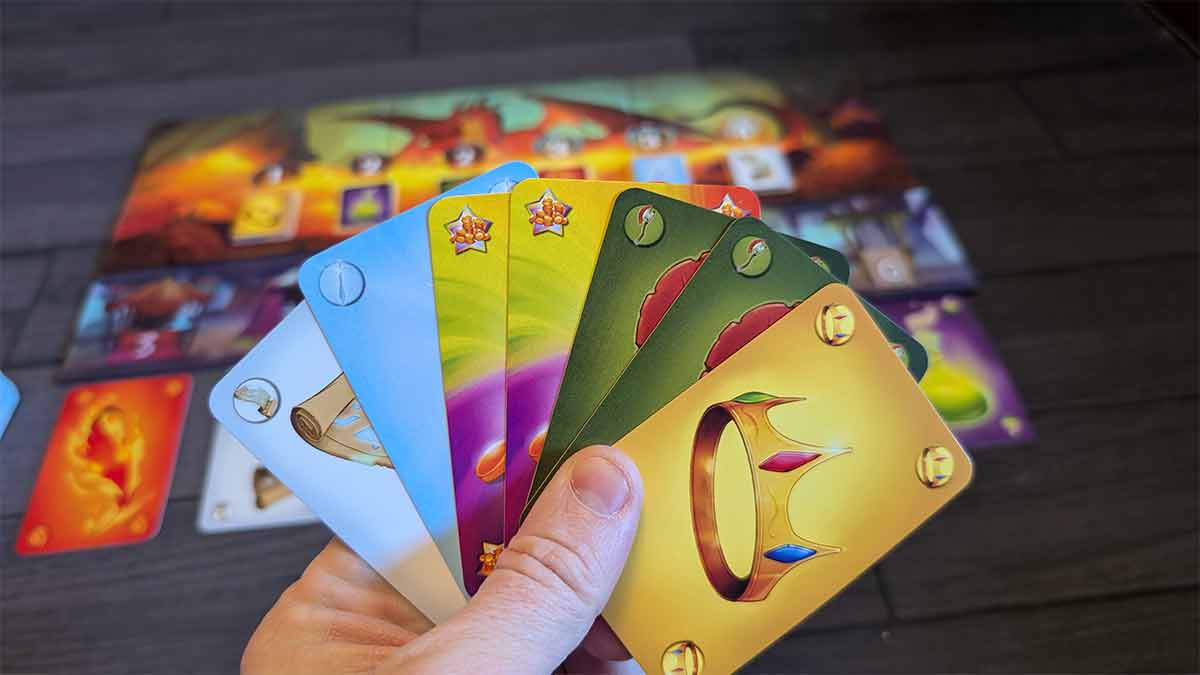
Deal 7 cards face down to each player as a starting hand.
Deal one card face up below the board under each of the six market spaces. Place the rest of the deck near the board with room for a discard pile.
The player who most recently set something on fire goes first.
Gameplay
Keeping with the game’s “simple is good” theme, gameplay is also very straight-forward.
On a player’s turn, they can do one of three things:
- Bribe the dragon
- Visit the black market
- Draw a card
Bribing the Dragon

You can place a bribe by playing a set of matching cards from your hand. A set can be one or more cards, as long as they’re all the same type of treasure. Wild cards can be added to this set, but it’s important to note that wilds cannot be played alone in their own stack.
The dragon is happy with your bribe, and yours being the most recent shiny thing it’s seen, it now values those treasures more, so you will adjust the value of the bribed treasure by shifting its token to the right on the dragon’s favor row by the number of cards you played. Treasure tokens you pass are shifted down one space. Tokens can not go above 4, so if you play more than that, you do not move the token further.
You can also add to an existing bribe: if you have more cards of a type you used to place a bribe earlier, you can add those to your existing bribe. You still adjust the dragon’s favor accordingly. Wild cards can be used here, even without other cards of that type.
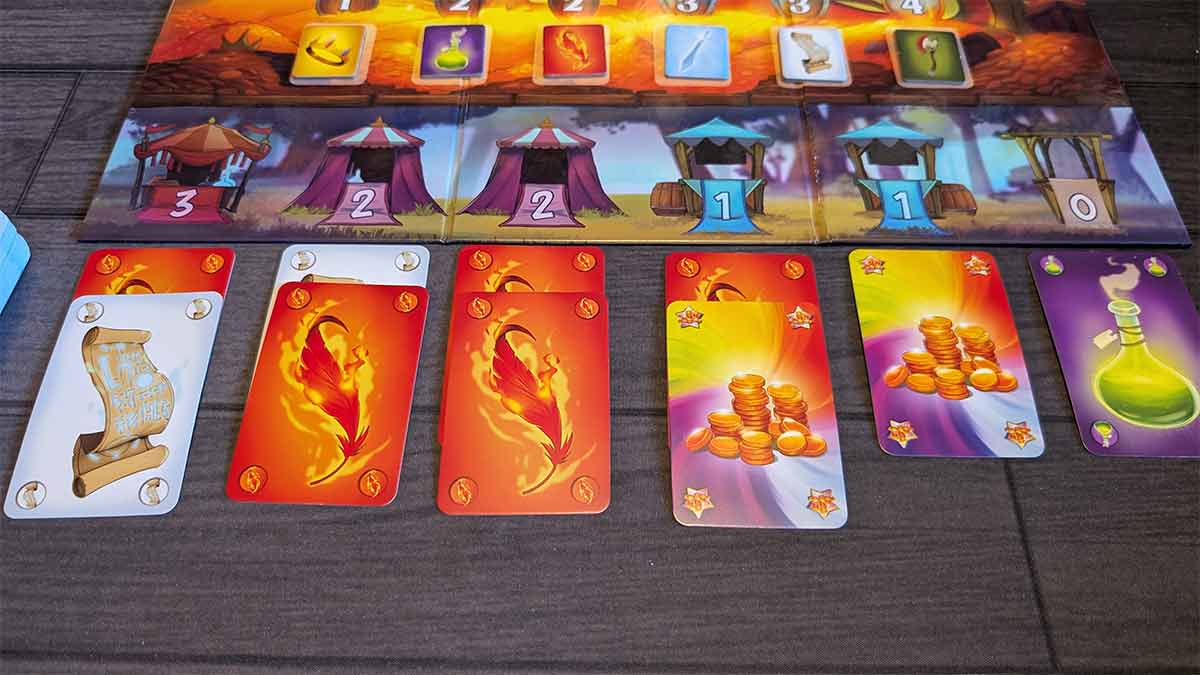
Once the bribe is placed and the market adjusted, you need to refill the black market. Always starting with the left-most space, draw cards from the deck and place one in each market space. Do this until you draw a card that is either a wild or one that matches the type used to bribe the dragon. If you reach the end of the row, start back at the left and continue.
Visit the Black Market

If you don’t have sets of cards you want to play, you can choose instead to visit the market. To do this, decide which market stall you want to collect from. Discard that number of cards to the discard pile and take all of the cards from that stall. Note that there are two stalls that require two cards, and two that require one, so you have the choice of either. The right-most column is always free to take, assuming there are any cards in it (and more often than not, there won’t be.)
While bribing the dragon pleases it and increases the value of items, taking from the market displeases the dragon and decreases the value of items. When you discard, you will select one of the cards you are discarding and put that on top. Then, you will decrease the value of that treasure by the number of cards you discarded.
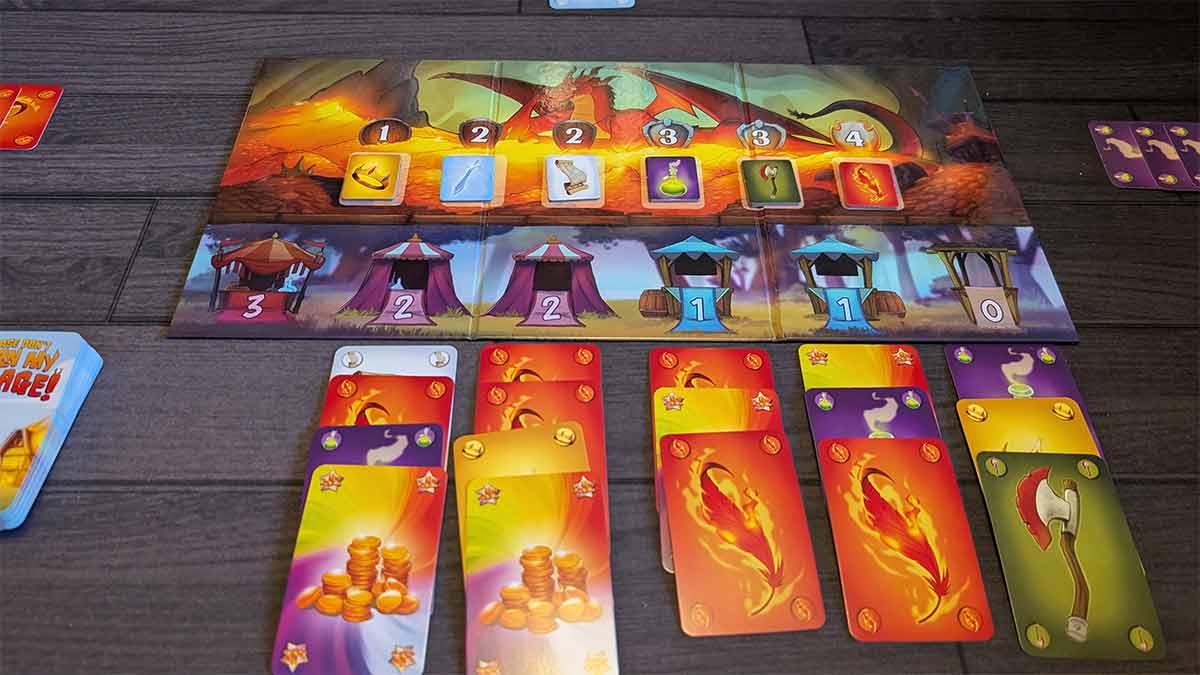
Note that you are allowed to discard wilds, but you cannot discard only wilds, and they cannot be the card you place on top.
There is no hand limit.
Draw a Card
Sometimes, you may not want to bribe the dragon and there may not be anything of interest in the market. (Or, you may not be able to do either because you’re out of cards.) In that case, your entire turn can consist of simply drawing the top card from the deck.
Game End

The game ends immediately when one of two conditions is met:
- A player is unable to draw a card from the deck because it’s empty
- A card cannot be added to the Black Market.
A few things to note. First, it’s possible for the game to end partway through a player’s bribing: if, in refilling the market, the deck runs out before a wild or card matching the bribe are drawn, the game is over immediately at that point.
But second, the game does not end the moment the last card is simply drawn from the deck. If a player draws the last card, or if, in filling the market after a bribe, the last card is either a wild or one that matches the bribe, then the game can continue. However, the only action that players can take without ending the game is visiting the market. While this adds cards to their hand, it also allows them to manipulate the market by devaluing treasures an opponent may be collecting.
Once the game is over, all players may try to empty their hand by playing any cards they have left on existing bribes they have. They canot create new stacks here, so they will be left with any cards that do not match something they’ve already played. Doing this does not alter the dragon’s favor row.
Wilds cannot be played at this time.
Scoring
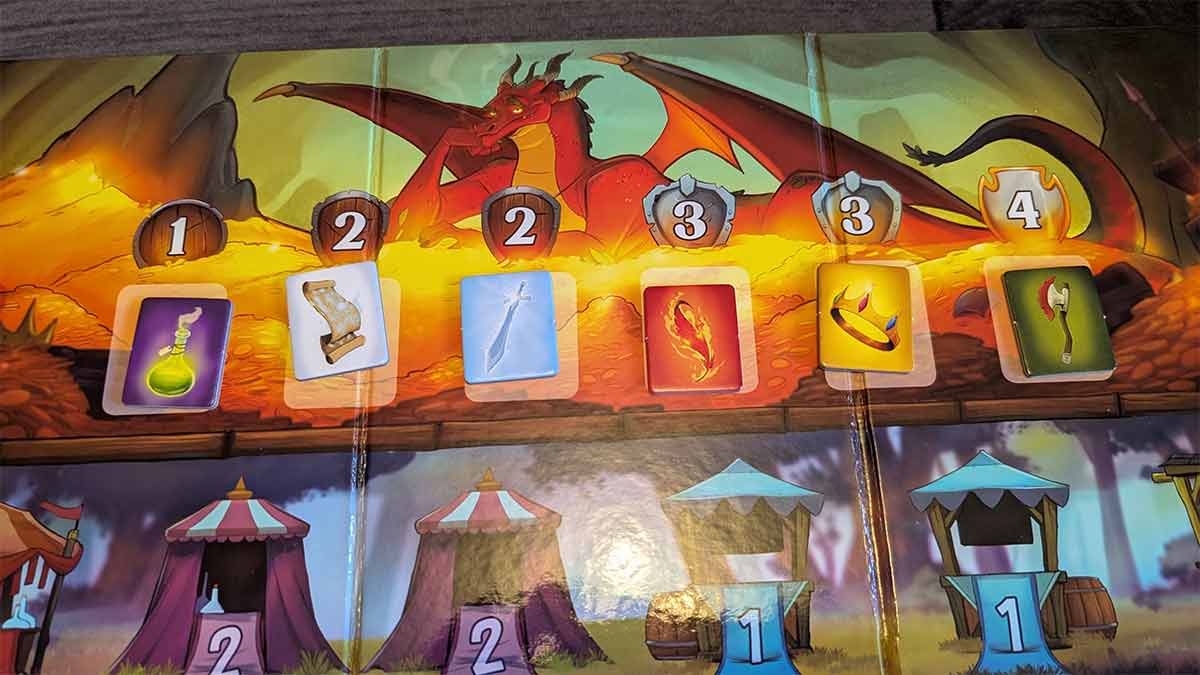
Players score points for each treasure they have in their bribes, based on that treasure’s final value. Wilds count as whatever treasure they were initially played as.
Players lose two points for each wild in their hand.

Players also lose points for every treasure card left in their hand at that treasure’s final value.

The player with the most points wins. If there’s a tie, the player with the most cards in the highest value treasure wins. If there’s still a tie, the winner is the player with the most cards in the second-highest treasure, and so forth.
Please Don’t Burn My Village is GeekDad Approved!
Why You Should Play Please Don’t Burn My Village
I’ve already mentioned that the game’s focus on simplicity is one of its strongest virtues. There’s no element in the game that is over designed, which makes it easy to pick up and learn and easy to play.
But, hidden in all of that simplicity is a surprising depth.
On every turn, you have to carefully consider which cards to play if you’re going to place a bribe. Obviously, you want to drive up the value of cards you have, but in so doing, are you actually helping an opponent who already has a lot of that? And when do you include wilds? There’s little point to ever playing more than the number of cards that will max out the value of the treasure, unless of course you’re competing with that other player for this treasure, and those wilds will give you the edge. But, is it still better to hold them to play later to drive the value back up?
When buying from the market, you’re always balancing the good versus the bad cards you’ll have to collect. But is that treasure you’ve decided to not care about really bad? You could take it and hold it, planning to use it in a later discard to drive the value down.
You also have to consider that every time you adjust the value of one treasure, you likely adjust the value of several others. Driving the value of a low-valued treasure decreases the value of everything above it, and vice-versa. This is one of the more interesting elements: a lot of market-manipulation games allow you to adjust one item without moving the rest, so your goal is to simply get whatever you care about the most value possible. But here, you have to weigh that against the other values, being careful not to increase one treasure you’re collecting withou negatively impacting another one you want as well.
The most interesting mechanic, though, is the reflling of the market. I like how it happens on turns where nothing is bought from the market–you replenish the market not when someone buys from it, but instead, when someone bribes the dragon. And, you never fill the market evenly: sometimes, a wild or the matching treasure will be the first one drawn, and so only the three spot gains cards. It’s been fairly common in my plays of the game to have those lower-level market stalls be empty for long portions of the game, thus ensuring that you always have to pay to get more than one card by blind draw.
You also have to factor in another element here: as each treasure is played as a bribe, and each treasure is discarded, the number of that treasure in the deck decreases. Therefore, as the game progresses, you are more and more likely to have to place many cards in the market for each bribe. This not only increases the number of cards in the stalls (and thus, decreases the amount you have to pay for those,) but it also hastens the end of the game. It’s entirely possible to look at the deck and assume you have several turns left, and then see just a few bribes come up on popular treasures and the deck get depleted very quickly. (If you’re the card counting type, there are only 14 of each treasure in the deck, and a total of 20 of wilds (minus those removed based on the player count.) You could therefore do some quick calculations to figure out the odds of a particular treason or a wild coming up in refilling the market.)
When I first got the game, it looked like a pretty straight-forward set collection/market manipulation game, and I thought it might be kind of fun as a quick game. As soon as I actually played it, though, I was impressed by the depth and the number of choices it presented. All in all, I think that while yes, it is a pretty straight-forward set collection/market manipulation game, it also has enough teeth to appeal to more intense gaming groups, and that’s why I’m giving it the GeekDad Approved seal.
Click here to see all our tabletop game reviews.
To subscribe to GeekDad’s tabletop gaming coverage, please copy this link and add it to your RSS reader.
Disclosure: GeekDad received a copy of this game for review purposes.
Swap stamps in the market to build the best collection!
What Is Stamp Showdown?
Stamp Showdown is a card game for 2 to 6 players, ages 10 and up, and takes about 20 minutes to play. It’s currently seeking funding on Kickstarter, with a pledge level of €15 (about $18USD) for a copy of the game; there are also other tiers for a print-and-play version or a deluxe edition.
Stamp Showdown was designed by James Ernest and published by Four Suit Studio, with illustrations by Rixt Heerschop.
New to Kickstarter? Check out our crowdfunding primer.
Stamp Showdown Components
Stamp Showdown is played with a standard poker deck, so I received draft rules for the game but did not get an actual prototype. The Kickstarter edition of the game is a custom deck of cards with stamp artwork, but you could play this with any regular card deck. You’ll need to provide some way of keeping score.

What you get in the box is a 54-card deck plus rules and two player aid cards, all in a small tuckbox. The deluxe edition will also include a larger box that has an unfolding magnetic flap that also serves as the market board and a scoreboard (with included dry-erase marker).

How to Play Stamp Showdown
You can download a copy of the rulebook here.
The Goal
The goal of the game is to score the most points by forming poker hands, made from swapping stamps with the market.
Setup
Shuffle the deck, removing certain cards if there are fewer than 6 players.
Deal 4 cards to each player, and 4 cards face-up in the center as a market.
Gameplay
The game will consist of 4 rounds, each of which lasts 7 turns.
Each turn, every player selects a card from their hand, and then everyone reveals their cards together. The player with the highest-ranked card will go first, and then turns follow in rank order. (Aces are high, and in the case of ties, the ranking of suits is spades, hearts, diamonds, clubs.)

When your number comes up, you swap the card you played with the market: you take all of the cards that match either the suit or the rank of your card, and then you add your card to the market. For instance, in the photo above, the player with the Queen of Diamonds will take three cards: the Ace of Diamonds, the Queen of Clubs, and then the 8 of Diamonds.
If your card does not match any of the cards in the market, then you choose one card to take, and then add your card to the market. (In the photo above, the Jack of Hearts will not match anything, so the player could choose either the Ace of Clubs or the Queen of Diamonds, which was added to the market by the previous player.)
Once every player has made a swap, the rest of the market is discarded and a new set of four cards is dealt for the next turn.
Round End
After 7 turns, there will be no more cards in the deck and it’s time for the showdown! Everyone makes their best 5-card poker hand from the cards they have, and then players score. First place gets 1 point per player, and each subsequent player scores one less, except for last place, which scores 0. (For example, in a 5-player game, scores would be 5-4-3-2-0.)
Then, collect all the cards and shuffle for the next round.
Game End
The game ends after four rounds—the highest score wins!
Why You Should Play Stamp Showdown
Stamp Showdown is another poker-adjacent game from Four Suit Studio, which delivered River Rats last year after a successful Kickstarter campaign in 2025. Where River Rats had players working together to build a single poker hand to defeat the titular bosses, Stamp Showdown is a competitive game, with each player trying to make the best hand. But where poker hands are usually built by random chance—with scoring based on betting and reading your opponents—in Stamp Showdown the hands are built through a series of swaps that make for some really intriguing decisions.
You start with only four cards in hand, which means that if you’re trying to build a hand that requires 5 cards (a full house, a straight, or a flush), then you really need a swap that gets you more than one card at once. And, of course, the more cards you manage to accumulate by the showdown, the better your chances are of building a good hand. So how do you get more than one card? Well, by matching multiple things at once.

In the photo above, the player on the left played a 10 of Spades, hoping to collect three cards (all of the Spades) at once. However, the player on the right played a Jack, which means they get to go first—and with no matches, they can take any single card. If they take the King, the other player still gets three cards, so it may make more sense for them to take one of the Spades, simply to reduce the number of cards the second player will get.
In many instances, you may have to make difficult choices about which card to play, not only because it determines which cards you can swap with but also because it determines the player order. The higher the card you play, the earlier you’ll get to swap—but that means somebody else might potentially swap for that high card, making their hand better than yours. Trying to dump your low cards means that you go late, which makes for a totally unpredictable market. You might just end up with another low card, but sometimes a better card gets swapped in that nobody else is able to take.
The nature of the swaps makes some things particularly hard to do. For instance, getting a four-of-a-kind is hard because you can never swap away any of the other three that you’ve collected, and you need to have the right suit to swap for the fourth. Also, you’re always required to swap one card, so ideally you want to get at least 6 cards in hand—there have been games where I had a full house, but then had to break it up because I needed to swap one of the cards!
The game feels really simple and doesn’t take long to explain, but I’ve played several times and I really love the way it tickles my brain, pondering which card in my hand to swap and hoping that the turn order works out in my favor. It’s just a very intriguing system, and most of the times when I’ve taught the game to people, I could see them having some “aha!” moments throughout the game as things started to click.
I like discovering new games that can be played with traditional poker decks, and this is certainly one that you could just play with whatever deck you have lying around. But if you want to support Four Suit Studio and more games like this, it’s also a pretty reasonable price for a cute custom deck of cards that fits the theme of the game.
For more information or to make a pledge, visit the Stamp Showdown Kickstarter page!
Click here to see all our tabletop game reviews.
To subscribe to GeekDad’s tabletop gaming coverage, please copy this link and add it to your RSS reader.
This is a short list of fun, engaging books that display craft and imagination.

Pencil & Eraser: New Friends Rule! by Jenny Alvarado (Author)
This is the third book in review on the site by Alvarado. Her graphic novels for early readers, which follow mundane school things like pencils and erasers, are both early-reader-friendly and fun to read.
Pencil and Eraser are best friends; however, a new friend is on the horizon! Ruler is perfect in everything she does: straight lines, ideas for goofiness, you name it. Eraser is having a hard time accepting a friend into their tight inner circle.
With Stella and the rest of the students due to be back from lunch time, they have to hurry up to find a missing green crayon. And, more importantly, can a dynamic duo become a trio without endangering a beautiful friendship?
Pencil & Eraser: New Friends Rule! is available since January 06, 2026.
Publisher: G.P. Putnam’s Sons Books for Young Readers
Pages: 80/ Hardback
EAN/UPC: 9780593699898
Up next, a pancake book:

Plenty of Pancakes by Carrie Finison (Author), Brianne Farley (Illustrated by)
Opossum Topsy has a bear friend hibernating. The bear’s name is LLou Ann. As Spring approaches, she is preparing a welcome party. She has invited plenty of forest animals to the party and is planning to make pancakes for the reception. So many pancakes! However, someone is eating them as soon as she whips them out of the pan, who?
As Topsy frantically makes more pancakes only to see them disappear, she is worried about her bear friend: Soon, there won’t be any left for her!
All her friends come to the rescue to get the feast done in time. Can they make enough pancakes to feed everyone? And, will we find out who the mysterious pancake snatchers are?
Plenty of Pancakes will be available on January 27, 2026.
Publisher: G.P. Putnam’s Sons Books for Young Readers
Pages: 40 Hardback
EAN/UPC: 9780593700174
Finally, what if the wild invaded our homes?

The Wildest Thing by Emily Winfield Martin (Author)
Eleanor loved wild things.
Every wing and wild sprout.There was something wild inside of her,
waiting to come out…
This is a poetic take on our desire to become one with Nature.
The dreamy images portray a girl who wants to give in to her wild side, wild meaning to live in a place where squirrels delve in her kitchen and there are no clear boundaries between inside and outside. A graceful book with poetic imagery, it resembles a dream where this desire comes true.
The Wildest Thing is on sale since January 06, 2026.
Published by Random House Books for Young Readers
Hardback | Pages: 48
ISBN: 9798217023981


Batman/Superman: World’s Finest #47 – Mark Waid, Writer; Adrien Gutierrez, Vicente Cifuentes, Artists; Tamra Bonvillain, Colorist
Ray – 9/10
Ray: One of the wackiest arcs of this run, Luthor and Joker have been fused into one being – and now, Superman and Batman have been as well. This has also had the unusual side effect of revealing all the secrets of the world in some sort of hive mind, and the heroes’ secret identities have been revealed to the public. This leads to a surprisingly emotional segment between “Superman” and Lois, although we all know it’ll be undone in time as this isn’t how the reveal happens. Batman and Superman are forced to figure out how to sync their thought patterns to protect their loved ones and win the day, while Luthor and Joker’s awkward partnership starts to quickly unravel as their bizarre natures are simply irreconcilable. This takes the strangest Silver Age concepts imaginable and fuses them just enough to create a compelling story in the modern day as well.

Catwoman #83 – Torunn Gronbekk, Writer; Danielo Beyruth, Joe Prado, Adriano Di Benedetto, Patricio Delpeche, Artists
Ray – 8.5/10
Ray: This is one of the most intense issues of the series yet, as Selina’s quest to get a valuable gem from under Carmine Falcone’s nose has run into an unexpected obstacle – the
Court of Owls. This ruthless, undead cult has invaded the conclave to carry out an execution, but to do this they’ve placed the entire facility under lockdown. This is around the same time that Falcone has noticed that the pearl has gone missing and unleashes hell in order to get it back. A brutal flashback shows just how he learned to conduct business this way. Selina, meanwhile, is in the middle of all this and needs to escape with her quarry and her life – but that’ll be easier said than done with the Talons prowling about. The story packs a lot of action into only 20 pages, with Selina being mostly off-panel or in disguise for much of it, and it feels like this is going to pick up speed as we head to the finale of this arc and Selina heads back to Gotham.
To find reviews of all the DC issues, visit DC This Week.
GeekDad received this comic for review purposes
]]>
Nightwing #134 – Dan Watters, Writer; V. Ken Marion, Artist; Veronica Gandini, Colorist
Ray – 9/10
Ray: The dark story of the Zanni and Olivia Pearce is reaching its apex, with Dick having entered a twisted circus in the spirit realm with the help of Martian Manhunter. As J’onn tries to explain to Barbara why this has to happen and Bryce continues to languish in a coma with kryptonite poisoning, Nightwing continues to descend into a nightmare world. This is clearly where Dan Watters gets to indulge in his taste for horror, as he creates an upside-down world filled with disturbing visuals. But when the Zanni challenges Dick to a game for control of the circus, things start getting all too real. The Zanni, with the help of the undead Olivia Pearce, has begun kidnapping children from around Bludhaven, including a literal baby. If Dick wins a series of twisted games, the children go home. But if the Zanni wins, Dick stays in the circus forever – and becomes its ringmaster of pain.

The first game is a simple carnival game of tossing balls to knock over tin cans, the predecessor of the carny games that are fleecing people at fairs to this day. But there’s a dark twist to it, of course – the cans reflect Bludhaven, and whatever happens to them happens to the city’s buildings. While Dick is struggling to balance this devil’s bargain, Barbara and J’onn desperately try to prevent the city from collapsing in on itself. The dark visuals of this issue make for a nice contrast with the more action-packed segments, and it’s interesting that this ties in so heavily with the 5th dimension stuff that Tom Taylor debuted with Nite-Mite. The concept is so often used with more comic elements in the Superman books that it’s pretty rare to see it used for horror, like it was very effectively during the Emperor Joker story long ago. This has been set up nightly for a big conclusion.
To find reviews of all the DC issues, visit DC This Week.
GeekDad received this comic for review purposes
]]>